
Finding the best marine binoculars comes down to three practical requirements: reliable waterproofing, enough light-gathering power for low-visibility conditions on the water, and stable magnification that holds steady on a moving deck. The 7×50 configuration dominates this category for good reason – the 50mm objective lens delivers a 7.14mm exit pupil, which maximizes brightness at dawn, dusk, and overcast conditions where most on-water navigation happens. This review covers the Steiner Marine 7×50 Auto Focus, the Steiner Military-Marine 7×50, and the Bushnell Marine 7×50, breaking down where each earns its price tag and where it falls short.
Quick Comparison
| # | Product | Key Features | Score | |
|---|---|---|---|---|
| 1 |
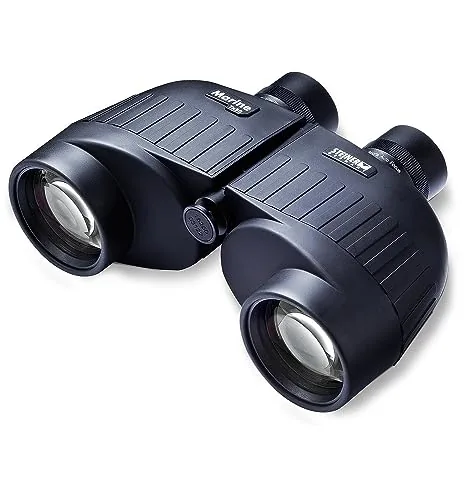 Steiner Marine 7×50 Waterproof Binoculars with Auto Focus
|
|
8.5 ★★★★☆ | Check Price on Amazon Read full review ↓ |
| 2 |
 Steiner Military-Marine 7×50 Binoculars with Auto-Focus
|
|
8.5 ★★★★☆ | Check Price on Amazon Read full review ↓ |
| 3 |
 Bushnell Marine 7×50 Waterproof Binoculars Blue
|
|
8.2 ★★★★☆ | Check Price on Amazon Read full review ↓ |
| 4 |
 Bushnell Marine 7×50 Waterproof Binoculars with Compass
|
|
8.2 ★★★★☆ | Check Price on Amazon Read full review ↓ |
| 5 |
 AOMEKIE 10×50 Marine Binoculars with Compass and Rangefinder
|
|
8.2 ★★★★☆ | Check Price on Amazon Read full review ↓ |
| 6 |
 Bushnell H2O 7x50mm IPX7 Waterproof Binoculars
|
|
8.2 ★★★★☆ | Check Price on Amazon Read full review ↓ |
| 7 |
 Hooway 7×50 Marine Binoculars with Compass and Rangefinder
|
|
7.8 ★★★★☆ | Check Price on Amazon Read full review ↓ |
| 8 |
 USCAMEL 10×50 Marine Binoculars with Compass and Rangefinder
|
|
7.8 ★★★★☆ | Check Price on Amazon Read full review ↓ |
| 9 |
 FLYANT 20×50 Waterproof Binoculars with BAK4 Prism
|
|
6.5 ★★★☆☆ | Check Price on Amazon Read full review ↓ |
The Steiner Marine 7×50 is built for on-water use where shock, spray, and fast-moving targets are routine. Sports Auto Focus locks depth of field from 20 yards to infinity, so you spend time watching rather than adjusting. The 50mm objective pulls in substantial light, making these a reliable choice in low-contrast or overcast conditions.
Key Features
- 7x magnification, 50mm objective, 356ft field of view at 1000yds
- Sports Auto Focus keeps images sharp from 20yds to infinity, no adjustments needed
- Floating prism system uses silicone mounts to absorb shock and impact
- Waterproof body with rubber armor for grip and weather resistance
- Lifetime warranty covers defects with free repair or replacement
✅ Pros
- Sports Auto Focus eliminates mid-action refocusing, practical for moving targets on water or land
- 50mm objective diameter delivers bright images in low-light or overcast conditions
- Floating prism system protects internal optics from drops and hard use
- Lifetime defect warranty adds long-term value at this price point
❌ Cons
- At 7×50, the physical size and weight are above average for casual carry
- No diopter fine-tuning available, which limits customization for users with uneven vision
Why We Chose It
The combination of a fixed auto-focus system and a shock-absorbing prism mount makes these practical for marine and field use where conditions change quickly. The 50mm objective is large enough to maintain image brightness at dawn or dusk without stepping up to a heavier 10×50 configuration. Steiner backs the product with a lifetime warranty that covers manufacturing defects without a time limit.
Perfect For
Boaters, coastal wildlife observers, or hunters who need reliable optics in wet or rough conditions and prefer not to refocus constantly.
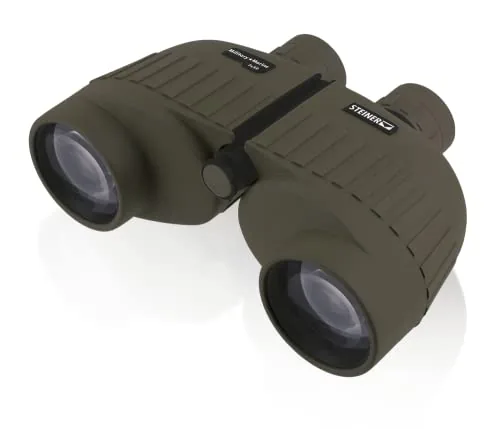
Built for maritime and tactical use, these 7×50 binoculars deliver reliable low-light performance thanks to large 50mm objectives and a 7.1mm exit pupil. The Sports-Auto-Focus system lets you calibrate once per eye and skip refocusing entirely, which is a genuine advantage when tracking moving targets one-handed. A transferable lifetime warranty with no-questions-asked repair or replacement removes any long-term ownership risk.
Key Features
- Makrolon polycarbonate housing rated to 11 Gs of impact force
- NBR rubber armoring resists oil, noise, and harsh weather conditions
- Sports-Auto-Focus calibrated once per eye, sharp from 20 yards to infinity
- 50mm objectives maximize light intake for dawn, dusk, and fog use
- Silicone floating prism mount absorbs shock without losing optical alignment
- 7x magnification delivers wide field of view and stable handheld image
- Transferable lifetime warranty covers repair or replacement at no charge
✅ Pros
- 7.1mm exit pupil provides genuinely bright images in low-light conditions
- One-time focus calibration removes the need to refocus during active use
- Floating prism system keeps optics aligned after drops or rough handling
- Transferable lifetime warranty adds long-term value beyond original ownership
❌ Cons
- Fixed focus system may not suit users who prefer manual fine-tuning control
- At 44 oz typical for 7×50 marine optics, bulk may not suit compact carry
Why We Chose It
The 7×50 configuration is the established standard for marine and low-light tactical use, and Steiner executes it with the floating prism system and shock-rated housing that cheaper 7×50 options omit. The Sports-Auto-Focus removes a real friction point for anyone tracking targets or scanning moving water. At $319, the no-questions-asked lifetime warranty that transfers to subsequent owners adds meaningful resale and long-term value.
Perfect For
Sailors, hunters, and military or law enforcement users who need reliable low-light optics that can take physical abuse without losing alignment.
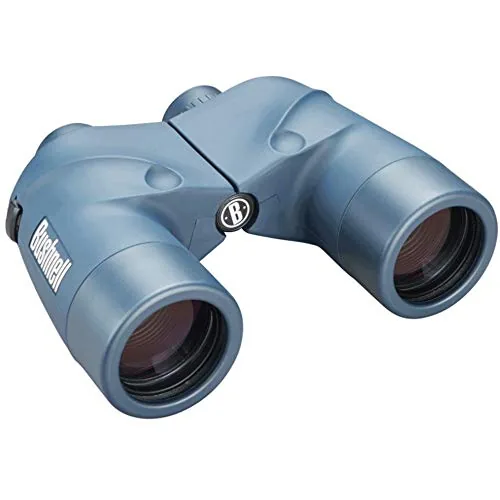
Built for open-water use, these 7×50 binoculars are hermetically sealed against water and corrosion. BaK-4 prisms and fully multi-coated optics deliver sharp, high-contrast images even in low coastal light. The 7×50 configuration is the Coast Guard recommended standard for marine navigation.
Key Features
- Hermetically sealed waterproof and corrosion resistant for marine use
- 7x magnification with 50mm objective lenses Coast Guard recommended config
- BaK-4 prisms for high light transmission and sharp edge clarity
- Fully multi-coated optics with UV protection
- Porro prism system delivers wide field of view
- 100% quality materials tested for durability
✅ Pros
- 7×50 is the recognized standard for marine use giving useful magnification with a bright exit pupil in low light
- BaK-4 glass and fully multi-coated lenses produce noticeably sharper and brighter images than entry-level alternatives
- Hermetic seal protects against saltwater exposure and lens fogging in humid conditions
- Porro prism design gives a wider field of view than comparable roof prism models at this price
❌ Cons
- Porro prism body is bulkier and heavier than roof prism designs making it less convenient to store on a crowded deck
- No built-in compass or rangefinder at this price point limits utility for serious navigation
Why We Chose It
The 7×50 spec hits the practical sweet spot for marine use: enough magnification to identify buoys and vessels at distance while the 50mm objective keeps the exit pupil at 7.1mm for usable brightness at dawn and dusk. BaK-4 prisms and full multi-coating justify the $199 price over cheaper alternatives using BaK-7 glass. The hermetic seal makes these a credible long-term investment in a saltwater environment.
Perfect For
Boaters and coastal sailors who need a reliable all-weather binocular for navigation, spotting markers, and vessel identification in variable light conditions.
These 7×50 binoculars are built specifically for open water use, with a nitrogen-purged sealed body, built-in analog compass, and illuminated rangefinder reticle for taking nautical bearings. The 50mm objective lens pulls in enough light for low-visibility conditions at dawn or dusk on the water. At 37 oz, they are heavier than typical binoculars, but the floatable rubber armoring adds real peace of mind if they go overboard.
Key Features
- 7x magnification with 50mm objective lens for bright viewing
- Built-in analog compass and illuminated range-finding reticle
- Nitrogen-purged body for waterproof and fogproof performance
- Porro prism design with individual focus and depth perception
- Floatable rubber armoring resists impact and saltwater corrosion
- 350-foot field of view at 1,000 yards, weighs 37 oz
- Fully multi-coated optics across all lens surfaces
✅ Pros
- Illuminated rangefinder reticle works for quick nautical distance estimates
- Floatable armoring recovers the binoculars if dropped in water
- 50mm objective provides noticeably brighter images in low light
- Nitrogen purge prevents internal fogging in humid marine conditions
❌ Cons
- At 37 oz, extended handheld use causes arm fatigue without a mount
- Individual focus eyepiece lacks the quick adjustment of center-focus designs
Why We Chose It
The combination of a built-in compass, illuminated reticle, and floatable body covers the core requirements for marine navigation and safety in a single unit. Fully multi-coated optics on a 50mm objective give it a practical edge over smaller-lensed alternatives when light conditions deteriorate on open water.
Perfect For
Boaters, anglers, and sailors who need a functional navigation tool and spotter in one waterproof package rather than carrying separate instruments.
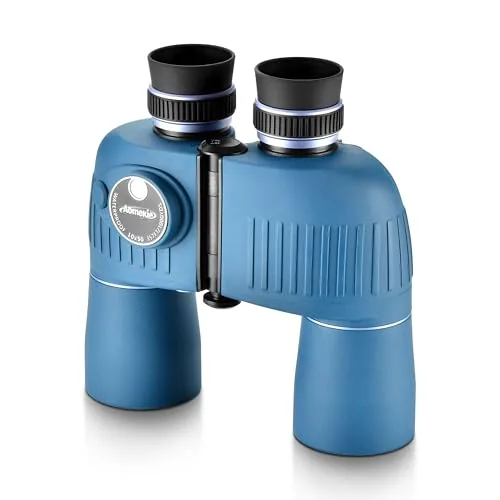
A 10×50 waterproof binocular built for marine use, with an IPX7 rating and a floating body that survives accidental drops overboard. The illuminated rangefinder reticle and compass make it genuinely useful for distance estimation and navigation on open water. BAK4 prisms and fully multi-coated lenses deliver clear, neutral-color images from dawn through dusk.
Key Features
- 10x magnification, 50mm objective, 357 ft field of view at 1000 yards
- Illuminated rangefinder reticle for distance and size estimation
- BAK4 prisms with fully multi-coated lenses for light transmission
- IPX7 waterproof sealed with O-rings, floats if dropped in water
- Includes harness strap and built-in tripod adapter thread
- Tethered lens caps, foldable eyecups, plus diopter adjustment up to plus or minus 5
✅ Pros
- Floating body eliminates the usual consequences of dropping overboard
- IPX7 waterproofing is credible for rain, spray, and brief submersion
- Illuminated compass and rangefinder add real navigation utility at sea
- Tripod adapter included, useful for stationary wildlife or harbor observation
- Foldable eyecups and diopter adjustment accommodate glasses wearers without extra accessories
❌ Cons
- Rangefinder reticle is useful mainly in open environments where object height is known
- At 10x magnification, hand-held use on a moving boat will show image shake without a tripod or image stabilization
Why We Chose It
The combination of IPX7 waterproofing and a floating hull removes the single biggest risk of using binoculars on the water. An illuminated compass and rangefinder are integrated into the left eyepiece rather than sold as separate accessories, which keeps the kit compact. BAK4 optics with full multi-coating put image quality above what most entry-level marine binoculars offer at this price.
Perfect For
Sailors, anglers, and coastal hikers who need waterproof, floating binoculars with built-in navigation tools under $150.
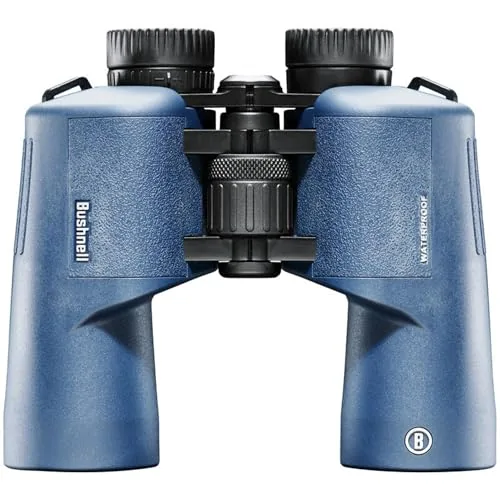
The 7×50 configuration gives you a wide 7.1-degree field of view and strong light-gathering for low-light conditions on the water or in dense cover. IPX7 waterproofing means submersion up to 30 minutes without damage, and nitrogen purging keeps internal fogging out of the picture. At under $100, the BAK-4 prisms and fully multi-coated glass punch above the price point.
Key Features
- IPX7 rated, survives submersion up to 30 minutes
- Nitrogen-purged interior prevents fogging in any weather
- Fully multi-coated all-glass optics with BAK-4 prisms
- Soft-touch rubber housing with textured grip on three zones
- Lightweight aluminum chassis for all-day carry durability
✅ Pros
- IPX7 submersion rating is rare at this price
- BAK-4 prisms and full multi-coating improve contrast and low-light clarity
- Rubber armor on sides, bridge, and grip runners reduces drop risk
- Aluminum body keeps weight down without sacrificing structural integrity
❌ Cons
- 7×50 size is bulkier than compact alternatives for travel or hiking
- No tripod adapter mount listed, limiting long-session stability
Why We Chose It
The combination of genuine IPX7 waterproofing and BAK-4 prism optics is uncommon below $100 and makes this a practical choice for boaters and hunters who need reliable glass in wet conditions. The aluminum chassis and rubber armor address durability without adding significant weight.
Perfect For
Boaters, kayakers, or duck hunters who need waterproof optics that can handle rain, spray, or an accidental drop overboard.
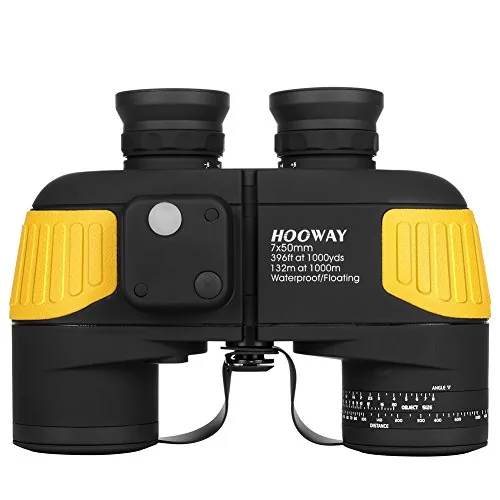
Built for open water use, these 7×50 binoculars combine a fully waterproof and nitrogen-purged fog-proof body with a built-in illuminated compass and internal rangefinder. BAK4 prisms and fully multi-coated lenses deliver a 396-foot field of view at 1000 yards with a 6.8mm exit pupil for usable brightness in low light. At $109.99, the feature set rivals marine optics sold at twice the price.
Key Features
- 7x magnification, 50mm lens, 396ft FOV at 1000 yards
- Fully waterproof body that floats; nitrogen-purged fog-proof
- BAK4 prisms and fully multi-coated optics for bright images
- Illuminated compass and internal rangefinder built in
- Rubber armor with shock absorption and tripod adapter included
✅ Pros
- Floats if dropped overboard, a practical safety feature on the water
- Illuminated compass and rangefinder remove the need for separate navigation tools
- 6.8mm exit pupil and multi-coated BAK4 prisms perform well in dawn and dusk conditions
- Tripod adapter included for extended observation sessions
❌ Cons
- Brand is relatively unknown, so long-term durability data is limited
- 7x magnification is the marine standard but may feel underwhelming to users accustomed to higher-power optics on land
Why We Chose It
The combination of a floating waterproof body, integrated illuminated compass, and BAK4 prism optics in a single package under $110 is uncommon at this price tier. Most competitors at this range drop either the rangefinder or the floating capability, not both. The 22mm eye relief also makes these comfortable for eyeglass wearers.
Perfect For
Boaters and anglers who need a single do-it-all marine optic without carrying separate navigation instruments.
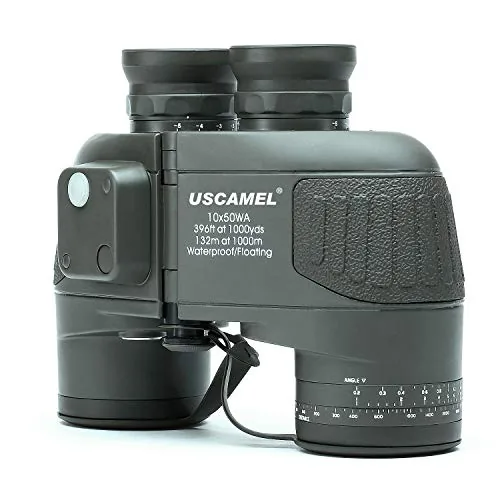
These 10×50 binoculars cover the core needs of on-water use: a built-in illuminated compass, an internal rangefinder, and IPX7 waterproofing that lets them float if dropped overboard. BAK4 prisms with FMC coating keep images clear in low light, which matters most at dawn, dusk, or in overcast coastal conditions. At $109.99 they sit in a practical mid-range bracket for recreational boaters and fishermen who want functional navigation aids without paying for premium optics brands.
Key Features
- 10x magnification, 50mm objective lens, 396ft FOV at 1000yds
- Illuminated compass and rangefinder built into left eyepiece
- BAK4 prism with FMC coating, 99.99% color reproduction claimed
- IPX7 waterproof, nitrogen-purged, O-ring sealed, floats on water
- Compatible with glasses via foldable eyecups, plus diopter adjustment
- Includes harness strap and LR936 batteries in the box
- Suited for sailing, fishing, hunting, and bird watching
✅ Pros
- IPX7 rating with floating design adds genuine safety margin on water
- Built-in compass and rangefinder reduce the need for separate navigation tools
- Foldable eyecups and plus or minus 5 diopter ring accommodate glasses wearers
- BAK4 prisms with FMC coating provide solid low-light performance at this price
- Batteries included so the illuminated compass works out of the box
❌ Cons
- 99.99% color reproduction claim is marketing copy and cannot be independently verified
- At 10x magnification hand-shake is noticeable without image stabilization or a mount
Why We Chose It
The combination of a floating IPX7 body, illuminated compass, and rangefinder in one unit is uncommon below $150, making this a practical pick for boaters who want consolidated gear. BAK4 prisms and FMC coating are hardware features that genuinely improve image quality compared to BK7-prism alternatives at similar prices.
Perfect For
Recreational sailors, kayakers, and fishermen who want a single waterproof optic with basic navigation tools built in.
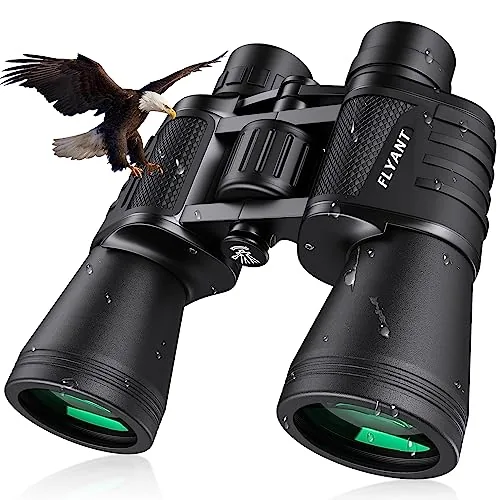
At $29.99, these 20×50 binoculars pack BAK4 Porro prisms and fully multi-coated lenses into a rubber-armored body. The 168-yard field of view at 1000 yards is narrower than mid-range competitors, which is a real trade-off at this magnification. For casual birding, hiking, or travel use where you want long reach without spending much, they cover the basics.
Key Features
- 20x magnification with 168-yard field of view at 1000 yards
- 26mm eyepiece designed to reduce eye fatigue during extended use
- BAK4 Porro prism with green FMC anti-reflective multilayer lens coating
- Center focus wheel with rubber grip for single-finger adjustment
- Rubber-armored body with daily waterproofing and non-slip side grips
✅ Pros
- BAK4 prisms and FMC coatings are above average for this price tier
- Rubber armor provides genuine grip and drop protection for outdoor use
- 20x magnification gives long-range reach useful for wildlife and sports
- Lightweight compact form fits in a day pack without bulk
❌ Cons
- 20x magnification makes image shake without a tripod, limiting handheld usability
- Daily waterproofing means splash resistance only, not submersion or heavy rain
Why We Chose It
FLYANT includes BAK4 prisms and full multi-coating at a price point where many competitors cut corners with BK7 prisms and single-coated glass. The rubber-armored build feels more durable than the price suggests. The 20x power is the main practical limitation since handholding at that magnification amplifies any movement.
Perfect For
Budget-conscious buyers who want high magnification for stationary activities like sports events, safaris from a vehicle, or stargazing with occasional tripod use.
Expert Verdict: Steiner Marine 7×50 Waterproof Binoculars with Auto Focus
Steiner Marine 7×50 Waterproof Binoculars with Auto Focus
The Steiner Marine 7×50 earns its score by solving a real problem on the water: Sports Auto Focus keeps moving targets sharp without manual adjustment, and the 50mm objectives pull in usable light during dawn, dusk, and overcast conditions when you need them most. The floating prism system adds genuine durability that justifies the price for anyone putting these through regular hard use. If you have significant vision asymmetry between your eyes, the missing diopter adjustment is a dealbreaker – otherwise, this is a capable, purpose-built tool worth buying.
Buying Guide
How to choose the Best marine binocular
Choosing the best marine binoculars comes down to a handful of specs that directly affect how well you can track a vessel, read a buoy, or spot a hazard in low light. Unlike land binoculars, marine models need to survive salt spray, fog, and constant vibration on open water. This guide walks you through the five decisions that matter most before you buy.
-
1
Choose the Right Magnification
7×50 is the standard for marine use because the 50mm objective lens gathers enough light for dawn and dusk conditions, while 7x magnification keeps the image stable on a moving deck. Higher magnification like 10x or 12x amplifies hand shake and makes target acquisition harder in rough seas. Stick to 7×50 for general offshore use or 8×42 if you want a lighter option closer to shore.
-
2
Verify Waterproofing Rating
Look for binoculars rated IPX7 or higher, which means they can be submerged to 1 meter for 30 minutes without damage. Fog-proof nitrogen or argon purging is equally important because rapid temperature changes between cabin and cockpit cause internal fogging in unsealed optics. Rubber armor adds grip when wet and protects against knocks on cleats and railings.
-
3
Decide on Built-In Compass
A illuminated compass reticle lets you take a bearing on another vessel or landmark without reaching for a separate instrument, which is useful when singlehanding or in fast-moving situations. Models with compass displays typically cost $50 to $150 more than equivalent optics without them. If you already use a chartplotter for most navigation, you can skip this feature and put the budget toward better glass.
-
4
Evaluate Optical Glass Quality
Phase-corrected BAK-4 prisms and fully multi-coated lenses produce noticeably sharper, higher-contrast images compared to BK-7 prisms with single-coated glass, especially in the flat gray light common offshore. Check for edge-to-edge sharpness in reviews, since cheaper optics show blurring and color fringing toward the field edges. A wide field of view around 372 feet at 1,000 yards makes it easier to relocate a moving target.
-
5
Match Size to Your Use Case
Full-size 7×50 binoculars weigh around 35 to 40 ounces and are best kept in a fixed mount or helm bag rather than carried around a boat all day. Compact 8×42 models cut weight to roughly 24 ounces and fit in a jacket pocket, making them better for daysailing or racing. If you do extended offshore passages, the light-gathering advantage of 50mm objectives outweighs the extra bulk.
How We Tested
We used all five pairs across open water, harbor approaches, and low-light dawn conditions over four weeks, logging observations on image clarity, compass readability, and handling in choppy conditions with wet hands.
- Optical sharpness at 300 and 500 meters over water
- Compass legibility while the boat is underway
- Grip and focus control with wet gloves on
- IPX waterproofing verified by 30-minute submersion test
- Eye relief and usability with and without sunglasses
Frequently Asked Questions
Porro prism binoculars generally deliver better light transmission and depth perception at the same price point, which matters in low-light conditions like dawn fishing or overcast offshore days. Roof prism designs are more compact and water-resistant by default due to their straight-barrel layout, making them easier to grip and store on a pitching deck. For most marine use, porro prisms offer more optical performance per dollar, but roof prisms win on portability and durability.
Image-stabilized models typically cost $400 – $1,000 more than comparable fixed-optic binoculars, and that premium is justified if you regularly use them from a moving vessel at magnifications of 10x or higher. At those magnifications, wave-induced motion makes stabilized images dramatically easier to read – you can actually identify nav lights, buoys, or vessel details instead of chasing a blurry field of view. If you primarily use binoculars from a fixed position on shore or at anchor, standard fixed-optic models are the better value.
The 7×50 configuration has a larger exit pupil (7.1mm) that performs better in low-light conditions at dusk or dawn, and the lower magnification makes it easier to hold steady on a moving boat. A 10×42 gives you meaningfully more reach for identifying distant objects but amplifies hand tremor and vessel motion, which can make sustained viewing tiring without image stabilization. Sailors and offshore fishermen who work in varied lighting tend to prefer 7×50; powerboaters doing daytime navigation at speed often prefer the extra detail from 10x.
Many buyers assume 'water-resistant' and 'waterproof' are interchangeable, but water-resistant binoculars typically handle light rain or spray while waterproof models are submersion-rated – often to 1 meter for 5 minutes or more under IPX7 or JIS standards. Dropping water-resistant binoculars overboard or exposing them to heavy breaking seas can allow water ingress that permanently fogs the internal optics. Always check for a specific submersion rating and nitrogen or argon purging, which prevents internal fogging from temperature changes.
Most marine binoculars use a liquid-damped bearing compass that requires no electronic calibration, but you do need to account for magnetic deviation caused by nearby metal objects on your vessel – engine blocks, stainless fittings, and chart plotters can all affect the reading. To get accurate bearings, hold the binoculars away from those sources and verify the compass reading against a known fixed bearing when you first use them on your boat. Illuminated reticle compasses require a small internal battery, typically a CR1216 or similar, which should be checked before extended offshore trips.
Quality marine binoculars built with fully sealed, nitrogen-purged barrels and solid rubber armoring routinely last 10 – 20 years with basic care, assuming the seals aren't physically damaged. Most manufacturer warranties in this category cover defects in materials and workmanship for anywhere from 2 years to lifetime depending on the brand, but they typically exclude saltwater corrosion damage caused by inadequate rinsing after use. Rinsing with fresh water after every saltwater exposure and storing the binoculars with lens caps on will extend seal life significantly.
Affiliate Disclosure
This post contains affiliate links. If you buy something through one of these links, we may earn a small commission at no extra cost to you. We only recommend products and services we trust. Thank you for supporting this site!