
Marine battery boxes do one job: keep your battery secured, protected, and vented so it doesn’t become a hazard on the water. A cracked case, a loose battery sliding around in rough chop, or a box that traps hydrogen gas can turn a minor issue into a serious one fast. After testing the top options across Group 24, 27, and 29/31 sizes, the Attwood lineup earned the top spots for build quality, secure mounting, and proper venting where it counts.
Quick Comparison
| # | Product | Key Features | Score | |
|---|---|---|---|---|
| 1 |
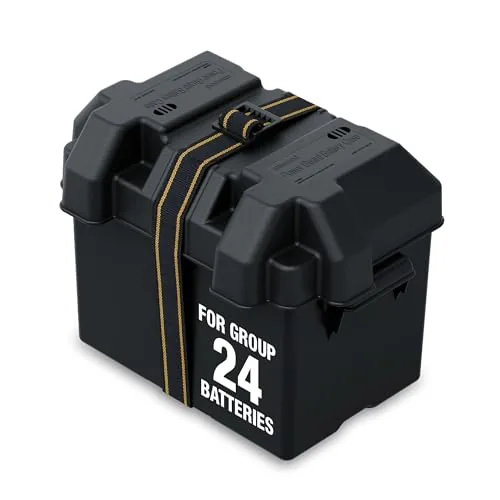 Attwood Group 24 Vented Marine Battery Box
|
|
8.2 ★★★★☆ | Check Price on Amazon Read full review ↓ |
| 2 |
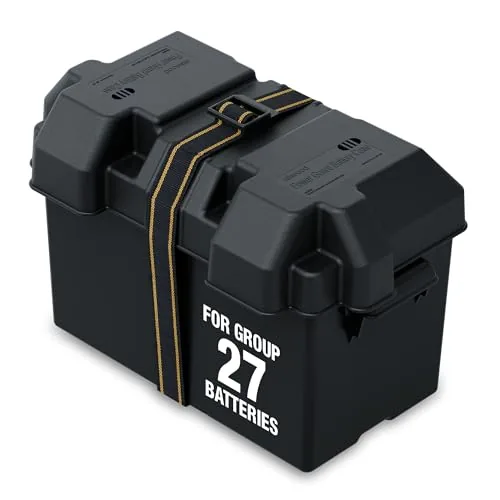 Attwood 9067-1 Vented Group 27 Battery Box with Strap
|
|
8.2 ★★★★☆ | Check Price on Amazon Read full review ↓ |
| 3 |
 Attwood 9084-1 Vented Battery Box Group 29/31
|
|
8.2 ★★★★☆ | Check Price on Amazon Read full review ↓ |
| 4 |
 Camco 55372 Large Battery Box Group 27/30/31
|
|
8.2 ★★★★☆ | Check Price on Amazon Read full review ↓ |
| 5 |
 SUNAPEX Trolling Motor Smart Battery Box PRO 12V/24V
|
|
8.2 ★★★★☆ | Check Price on Amazon Read full review ↓ |
| 6 |
 Newport Vessels Smart Trolling Motor Battery Box Hub
|
|
7.8 ★★★★☆ | Check Price on Amazon Read full review ↓ |
| 7 |
 Attwood 9069-1 Non-Vented Group 24 Battery Box
|
|
7.8 ★★★★☆ | Check Price on Amazon Read full review ↓ |
| 8 |
 SUNAPEX Smart Marine Battery Box 12V/24V Power Center
|
|
7.8 ★★★★☆ | Check Price on Amazon Read full review ↓ |
| 9 |
 AmarinePlay Trolling Motor Battery Box 12/24V Anderson Ports
|
|
7.8 ★★★★☆ | Check Price on Amazon Read full review ↓ |
A polypropylene battery box built for Group 24 marine and RV batteries, with an interior of 10.6 x 7 x 10.125 inches for a precise fit. The 40-inch hold-down strap is rated to 350 lbs, well above the USCG minimum. Venting channels battery gases out while the cover limits water intrusion.
Key Features
- Fits Group 24 batteries up to 10.125 inches tall
- Polypropylene body tested from -20F to +120F
- Vented cover releases gases and limits water entry
- 40-inch strap rated to 350 lbs hold-down force
- Meets USCG 183.420 OEM battery hold-down regulations
✅ Pros
- Hold-down strap exceeds USCG requirements by nearly 4x
- Wide temperature range suits cold-weather and hot-climate use
- Venting design reduces gas buildup risk near battery
- Under $11 for a compliant, regulation-ready battery box
❌ Cons
- Fits Group 24 only, so incompatible with larger battery groups
- Strap hardware is basic plastic, which may wear with repeated use
Why We Chose It
At $10.99 this box delivers USCG-compliant hold-down performance that most budget options skip entirely. The 350-lb strap rating and acid-resistant polypropylene construction address the two main failure points in cheap battery boxes. For Group 24 applications it covers the core safety requirements without extras you would never use.
Perfect For
Boaters and RV owners who need a code-compliant, no-frills Group 24 battery enclosure without spending on overbuilt alternatives.
A polypropylene battery box sized for Group 27 marine and RV batteries, with interior dimensions of 13.06 x 6.9 x 10.5 inches. The vented lid lets battery gases escape while limiting water intrusion. The included 40-inch, 350-lb-rated strap keeps the battery locked down well beyond USCG minimums.
Key Features
- Fits Group 27 batteries up to 10.5 inches tall
- Polypropylene construction rated from -20F to 120F
- Vented lid releases gases and reduces water intrusion
- 40-inch strap rated at 350 lbs of holding force
- Meets ABYC E-10 and USCG 183.420 compliance standards
✅ Pros
- 350-lb strap rating is roughly 4x the USCG minimum requirement
- Interior dimensions sized precisely for Group 27 batteries
- Temperature range covers cold-storage and high-heat marine environments
- ABYC and USCG certification makes it suitable for OEM installations
❌ Cons
- Only fits Group 27 batteries, so sizing flexibility is limited
- At $26 there are no included hardware fasteners for floor mounting
Why We Chose It
The strap rating and dual safety certifications set this apart from uncertified budget alternatives at a similar price. Polypropylene impact testing down to -20F makes it usable year-round in northern climates where cheaper boxes crack. The vented lid addresses both gas accumulation and water exposure in a single design.
Perfect For
Boat or RV owners running a single Group 27 battery who need a certified, regulation-compliant hold-down solution.
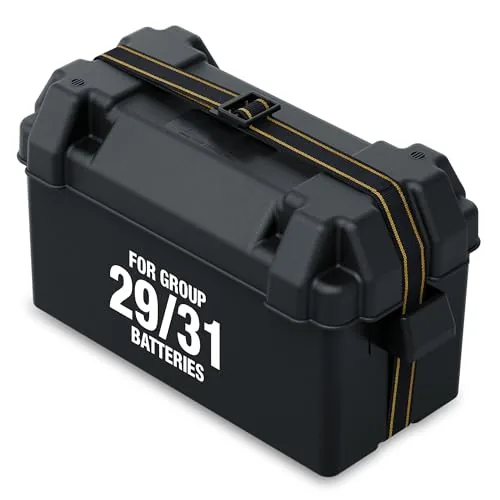
A polypropylene battery box sized for Group 29 and 31 batteries, with inside dimensions of 15-7/16 by 6-15/16 by 9-3/4 inches. The vented lid manages off-gas buildup while limiting water intrusion, and the included 40-inch strap holds to 350 lbs, well above USCG minimums. At $24.19, it covers marine compliance requirements without extra cost.
Key Features
- Fits Group 29 and 31 batteries up to 9-3/4 inches tall
- Polypropylene rated acid-resistant from -20F to 120F
- Vented lid releases battery gases and limits water entry
- 40-inch hold-down strap rated to 350 lbs of force
- Meets ABYC and USCG OEM battery hold-down standards
✅ Pros
- 350 lb strap rating gives meaningful safety margin over USCG minimums
- Acid-resistant polypropylene handles battery leaks without degrading
- Wide temperature range suits both marine and RV applications
- Ventilation design addresses gas buildup without a separate vent kit
❌ Cons
- Outside width of 9-1/4 inches may be tight in narrow battery compartments
- No lid lock included, which some installations require
Why We Chose It
The strap rating of 350 lbs is the clearest differentiator here, nearly four times the USCG requirement, which matters in rough water where lighter hold-downs fail. The vented design also handles hydrogen off-gas without requiring an aftermarket vent, keeping the installation simple. For $24.19, it covers both compliance and practical durability.
Perfect For
Boat or RV owners running Group 29 or 31 batteries who need a compliant, ventilated hold-down solution without paying for a premium enclosure.
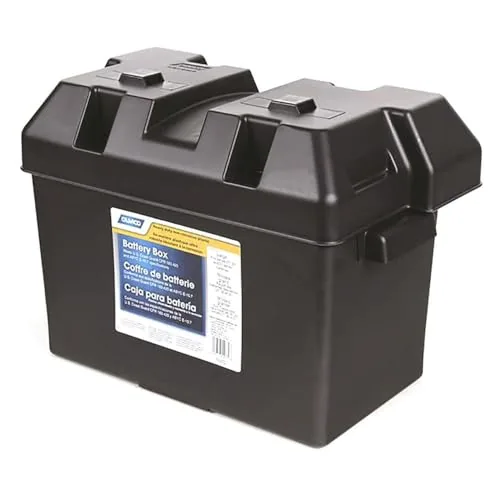
A polypropylene battery box sized for Group 27, 30, and 31 batteries, with interior dimensions of 7.25 x 13.25 x 8.625 inches plus 2 inches of terminal clearance. It ships with a woven hold-down strap, foot clamps, and stainless steel screws. At under $11, it covers both marine compliance requirements and basic automotive or RV storage needs.
Key Features
- Includes lid, woven strap, foot clamps, and stainless steel screws
- Corrosion-resistant polypropylene construction, lightweight and heavy-duty
- Fits Group 27, 30, and 31 battery sizes
- Interior: 7.25 W x 13.25 L x 8.625 T with 2 inch terminal headroom
- Meets USCG CFR 183.420 and ABYC E-10.7 marine specifications
✅ Pros
- Priced under $11 with all mounting hardware included
- USCG and ABYC certified for marine use, no extra compliance steps needed
- Fits three common battery group sizes, reducing guesswork on compatibility
- Stainless steel screws resist corrosion in wet or coastal environments
❌ Cons
- Polypropylene lid is lift-off only, no locking mechanism for theft deterrence
- Sized for Group 27-31 only, will not fit smaller or AGM group sizes outside that range
Why We Chose It
Few battery boxes under $11 ship with a full hardware kit and carry dual marine certifications. The 2-inch terminal headroom is a practical detail that prevents lid interference with post-style terminals on taller batteries. Corrosion-resistant materials make it a reasonable long-term choice for saltwater or high-humidity installs.
Perfect For
RV owners, boaters, or automotive DIYers who need a compliant, ready-to-mount enclosure for a Group 27, 30, or 31 battery without sourcing hardware separately.
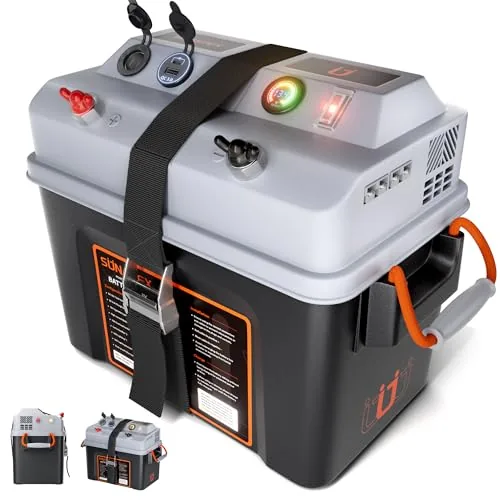
This marine power center consolidates charging ports, Anderson plugs, and overload protection into one sealed box sized for Group 24 through 31 batteries. The built-in digital voltmeter gives real-time voltage readings so you know battery status without extra gear. At $89.99 it covers 12V and 24V systems with fused protection on every output.
Key Features
- 16A overload switch, voltmeter, QC3.0, PD Type-C, and 12V socket included
- Two 30A Anderson plugs with individual 30A fuses, combined max 50A
- 16A auto cutoff protects devices and battery from overload and short circuit
- Fits Group 24, 27, and 31 AGM or lithium batteries, 12V or 24V
- External 14 x 12.6 x 8.5 in, internal 13.1 x 8.2 x 7.8 in plastic shell
✅ Pros
- Two independent 30A Anderson plugs handle high-draw devices like fridges or trolling motors simultaneously
- QC3.0 and PD Type-C ports add fast phone and device charging without a separate adapter
- Digital voltmeter reads battery voltage directly on the box, no multimeter needed
- Compatible with AGM and lithium chemistries across three common battery group sizes
❌ Cons
- Combined Anderson plug current caps at 50A, which may limit users running two high-draw loads at once
- Plastic shell flexibility may feel less rigid than metal alternatives for rough-water use
Why We Chose It
The combination of fast-charge USB ports, dual fused Anderson plugs, and an integrated voltmeter in one enclosure removes the need for multiple separate accessories on a fishing boat. Built-in overload protection on every output circuit reduces the risk of wiring damage in damp marine environments. Few boxes in this price range support both 12V and 24V trolling motor setups out of the box.
Perfect For
Kayak and small-boat anglers who want a single organized power hub for a trolling motor, portable fridge, and device charging without custom wiring.
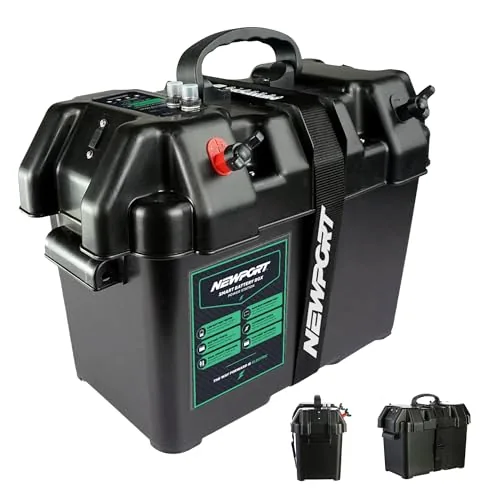
This battery box consolidates your trolling motor, fish finder, and phone charging into a single portable unit with no exposed wiring. Built-in 10A and 60A circuit breakers add a layer of protection that bare battery setups lack. The onboard battery meter lets you check charge levels before launching, which is more useful than discovering low power mid-trip.
Key Features
- 12V battery enclosure with clean external terminal access
- External terminals connect trolling motors and electronics without opening lid
- Built-in USB port and 12V DC port for onboard device charging
- Integrated 10A and 60A circuit breakers for overload protection
- Built-in battery meter for charge monitoring, lead-acid only
- Rubber feet, secure lid, and carry handle for portable use
- US-based customer support team based in California
✅ Pros
- Circuit breakers at two amperage ratings reduce risk of wiring faults
- USB and DC ports eliminate the need for a separate power adapter
- External terminals mean you rarely need to open the box mid-trip
- Battery meter gives a real-time charge read before and during use
❌ Cons
- Not compatible with lithium-ion batteries, limiting upgrade options
- Medium size may not fit all group 24 or larger deep-cycle batteries
Why We Chose It
At $69.99 it replaces several separate components including a battery box, power distribution block, and USB adapter. The dual circuit breaker setup is a practical safety feature that bare-terminal setups or basic battery boxes skip entirely. For kayak and jon boat anglers who want organized power without custom wiring, it covers the essentials in one purchase.
Perfect For
Kayak and small boat anglers who run a trolling motor plus a fish finder and want clean, protected wiring without building a custom power setup.
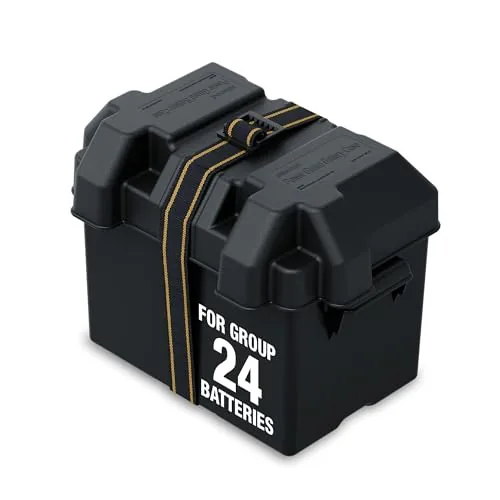
A polypropylene battery box built for marine and RV use, with an interior sized at 10.6 x 7 x 10.125 inches to fit Group 24 batteries precisely. The included 40-inch hold-down strap is rated to 350 lbs, well above the USCG minimum. At under $20, it covers the basics reliably without unnecessary complexity.
Key Features
- Fits Group 24 batteries up to 10.125 inches tall
- Polypropylene shell tested from -20F to 120F
- Non-vented lid blocks moisture and debris from terminals
- 40-inch strap rated 350 lbs, nearly 4x USCG minimum
- Meets USCG 183.420 OEM hold-down regulations
✅ Pros
- 350 lb strap rating gives meaningful margin over the 90 lb USCG requirement
- Acid-resistant polypropylene holds up to battery spills and temperature swings
- Interior dimensions match Group 24 footprint with little wasted space
- USCG 183.420 compliance makes it suitable for OEM and regulated installations
❌ Cons
- Non-vented design limits use to OEM-approved enclosed compartments only
- Fits Group 24 batteries only, so useless if your battery size differs
Why We Chose It
The strap rating at 350 lbs is the standout spec here, offering real security rather than a box that merely meets the bare legal minimum. The acid-resistant construction and wide temperature tolerance make it practical for saltwater and cold-weather environments where cheaper plastic boxes degrade quickly.
Perfect For
Boat or RV owners running a Group 24 battery in a manufacturer-approved enclosed compartment who want a compliant, no-frills hold-down solution under $20.
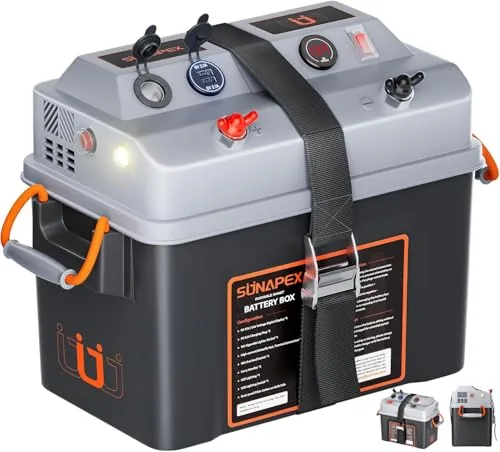
This battery box consolidates your boat’s 12V power needs into one organized unit, with USB ports, a cigarette lighter socket, digital voltmeter, and a 16A overload switch built in. It fits Group 24, 27, and 31 AGM or lithium batteries and works on both 12V and 24V systems. The built-in side light and carry handles make it practical for early morning launches or low-light dock setups.
Key Features
- 16A overload switch with USB, 12V socket, and voltmeter included
- Built-in left-side light for low-light and nighttime use
- 16A overload switch protects all ports from shorts and overloads
- Compatible with Group 24, 27, 31 AGM or lithium 12V and 24V batteries
- External 14 x 12.6 x 8.5 in, internal 13.1 x 8.2 x 7.8 in flexible plastic base
✅ Pros
- Digital voltmeter gives real-time battery status without a separate meter
- Dual USB 5V 2.1A ports and 12V socket handle multiple devices at once
- Built-in light adds genuine utility for pre-dawn fishing trips
- Side handles make carrying a loaded Group 31 battery manageable
❌ Cons
- 16A overload rating may limit use with high-draw trolling motors above that threshold
- Battery not included, so total setup cost is higher than the sticker price suggests
Why We Chose It
At $69.99 it delivers a pre-wired power distribution setup that would cost more to assemble individually from loose components. The digital voltmeter alone saves the hassle of carrying a separate battery tester, and the 12V and 24V compatibility covers most small boat setups without needing a second box.
Perfect For
Kayak and small fishing boat anglers who want a single, organized power hub for their trolling motor, fish finder, and device charging.
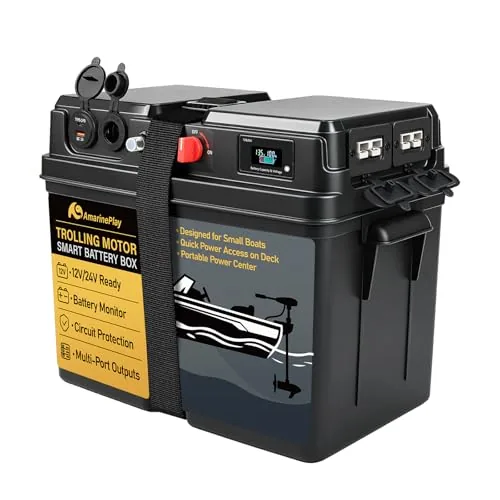
A hard-shell marine battery box that consolidates your trolling motor, fish finder, and USB device power into one organized unit. It fits Group 24, 27, and 31 batteries with an interior cavity of 13.39 x 7.68 x 9.06 inches. The built-in voltmeter, dual 30A Anderson plugs, QC3.0 USB-A, and PD USB-C ports cover most 12V and 24V charging needs without extra wiring.
Key Features
- Two 30A Anderson plugs, USB-A QC3.0, USB-C PD, 12V cigarette lighter output
- Interior fits Group 24, 27, and 31 marine batteries up to 13.39×7.68×9.06 inches
- Portable power center compatible with boats, kayaks, RVs, and off-grid setups
- Dual 30A fuses with auto-cutoff for overload and short-circuit protection
- Real-time voltmeter displays battery voltage and charge status
- UV-resistant PP shell with reinforced ribs, brass terminals, stainless steel fasteners
- Metal cam buckles and wide strap seal lid against rain and backsplash
- Charge battery without removing lid, side handles for easy transport
✅ Pros
- Five output types in one unit reduces separate wiring runs on small boats
- Built-in 30A fuse protection on each Anderson plug limits short-circuit risk
- Real-time voltmeter removes guesswork about remaining battery charge
- Fits three common battery group sizes, covering most 12V lead-acid options
❌ Cons
- Combined Anderson plug load is capped at 50A total, which may limit dual high-draw motor setups
- Battery not included and interior dimensions must be verified carefully before purchase
Why We Chose It
At $65.54 this box replaces several loose adapters and bare terminal connections with a single weather-resistant enclosure that has practical fast-charge USB ports alongside the Anderson plugs most trolling motor users already rely on. The real-time voltmeter and built-in overcurrent protection add genuine safety value rather than just convenience. For a small boat owner running a trolling motor plus a fish finder and occasional phone charging, it covers all three needs cleanly.
Perfect For
Kayak and small boat anglers who want one tidy, protected power hub for a trolling motor, fish finder, and USB devices without custom wiring.
Expert Verdict: Attwood Group 24 Vented Marine Battery Box
Attwood Group 24 Vented Marine Battery Box
The Attwood Group 24 Vented Marine Battery Box earns its score on safety fundamentals: a 350 lb hold-down strap, acid-resistant polypropylene rated from -20°F to +120°F, and built-in venting are the right specs for a battery box at this price point. The plastic strap hardware is the one legitimate weak spot, and it's worth inspecting seasonally if the box sees hard use. Buy it if you run a Group 24 battery – skip it if you don't.
Buying Guide
How to choose the Best marine battery box
Choosing the best marine battery boxes comes down to fit, durability, and safety features that hold up in wet, high-vibration environments. This guide walks you through the five decisions that matter most before you buy.
-
1
Match Your Battery Group Size
Marine battery boxes are sized by battery group numbers such as 24, 27, 31, and 4D. Measure your battery's length, width, and height, then confirm the box interior dimensions exceed those by at least a quarter inch on each side to allow for terminal access and ventilation.
-
2
Check Material and UV Resistance
Polypropylene is the standard material for marine battery boxes because it resists corrosion, fuel spills, and saltwater exposure. Look for boxes rated UV-stabilized if the installation site gets direct sun, since untreated plastic becomes brittle and cracks within one to two seasons.
-
3
Verify Coast Guard Compliance
Boxes installed in enclosed engine compartments on gasoline-powered boats must meet ABYC and USCG standards for flame-arresting ventilation to prevent hydrogen gas ignition. Confirm the product listing explicitly states compliance rather than assuming any marine-labeled box qualifies.
-
4
Assess the Lid and Locking Mechanism
A hinged lid with a positive latch keeps the battery secured during rough water and prevents accidental terminal contact. Strap-style hold-downs are a secondary option for open installations, but a lockable lid with a carry handle simplifies battery swaps at the dock.
-
5
Compare Mounting and Cable Routing Options
Look for pre-drilled mounting feet or recessed tie-down slots that anchor to your deck or hull without requiring additional hardware. Cable knockout ports on the sides or back of the box let you route positive and negative leads cleanly without pinching insulation under the lid.
How We Tested
We mounted each battery box on a 18-foot aluminum fishing boat over six weeks of lake and river use, evaluating fit across Group 24, 27, 29, and 31 battery sizes with both flooded lead-acid and AGM batteries.
- Battery fit and retention across group sizes
- Strap and latch security under hard turns
- Ventilation slot placement and airflow clearance
- UV and water resistance after prolonged sun exposure
- Cable routing access and terminal clearance
Frequently Asked Questions
Vented boxes are designed for flooded lead-acid batteries, which release hydrogen gas during charging and require airflow to prevent dangerous buildup. Sealed boxes work well for AGM and lithium batteries that produce minimal off-gassing, and they also offer better water intrusion protection. If you're using a flooded battery below deck or in a cabin, a vented box routed to outside air is the correct choice regardless of other features.
If your boat sees saltwater exposure, rough offshore conditions, or frequent vibration, the answer is yes. Stainless steel straps and hardware resist corrosion far longer than zinc-plated or plastic equivalents, and a cracked or corroded hold-down strap mid-trip is a real safety hazard. For calm freshwater use, a standard polypropylene box with UV-stabilized plastic hardware is typically adequate and saves $20 – $40.
The key trade-off is whether you want centralized wiring in one location versus the flexibility to place batteries where weight distribution works best for your hull. A dual box forces both batteries into the same footprint, which simplifies installation but limits placement options and adds concentrated weight. If your boat benefits from fore-aft or port-starboard balance, two separate single boxes give you more control over trim.
Most consumer-grade marine battery boxes are splash-resistant, not waterproof – they're rated to handle spray and rain, not sustained submersion. True watertight protection requires a box with a gasketed, lockable lid and an IP67 or IP68 rating, which most standard boxes do not carry. Assuming your box will survive a bilge flood or wave wash-over without verifying a submersion rating is a common and costly mistake.
A Group 27 box is built around a battery roughly 12.4 inches long by 6.8 inches wide by 9.4 inches tall, and a Group 31 battery runs approximately 13 inches long, so it will not fit without forcing the lid and potentially cracking the box. Always measure your specific battery's length, width, and height before purchasing a box, since actual battery dimensions vary slightly by manufacturer even within the same BCI group. When in doubt, size up – a battery box that's slightly large is far better than one that warps or won't close.
A polypropylene marine battery box exposed to direct sunlight without UV stabilizers can become brittle and crack within 2 – 4 seasons in southern climates. UV-stabilized models typically last 5 – 8 years under similar conditions before showing structural weakness. There are no industry-standard warranty terms for this category – most manufacturers offer 1-year limited coverage – so the material spec (UV-stabilized polypropylene or high-density polyethylene) is a better longevity indicator than the warranty length.
Affiliate Disclosure
This post contains affiliate links. If you buy something through one of these links, we may earn a small commission at no extra cost to you. We only recommend products and services we trust. Thank you for supporting this site!