
Finding a reliable marine battery matters more when you’re 10 miles offshore than when you’re shopping in a store. After testing AGM and dual-purpose options across starting and deep-cycle demands, three batteries consistently outperformed the rest: the OPTIMA D34M BlueTop, the OPTIMA 34M BlueTop, and the Interstate AGM Marine RV 12V 70Ah. This guide breaks down exactly what separates them so you can buy with confidence before you leave the dock.
Quick Comparison
| # | Product | Key Features | Score | |
|---|---|---|---|---|
| 1 |
 OPTIMA D34M BlueTop AGM Dual Purpose Battery
|
|
8.5 ★★★★☆ | Check Price on Amazon Read full review ↓ |
| 2 |
 OPTIMA 34M BLUETOP AGM Dual-Purpose Marine Battery
|
|
8.5 ★★★★☆ | Check Price on Amazon Read full review ↓ |
| 3 |
 Interstate AGM Marine RV Battery 12V 70Ah Dual Purpose
|
|
8.2 ★★★★☆ | Check Price on Amazon Read full review ↓ |
| 4 |
 Newport Vessels 12V 50Ah Sealed AGM Marine Battery
|
|
8.2 ★★★★☆ | Check Price on Amazon Read full review ↓ |
| 5 |
 Interstate AGM Group 31 Marine/RV Battery 100Ah 925CCA
|
|
8.2 ★★★★☆ | Check Price on Amazon Read full review ↓ |
| 6 |
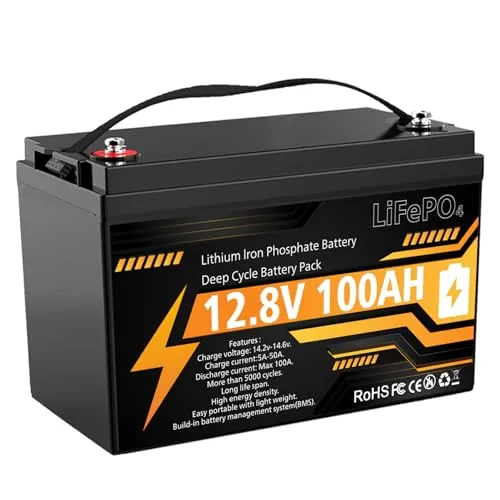 VEMDIA 12V 100Ah LiFePO4 Group 31 Deep Cycle Battery
|
|
8.2 ★★★★☆ | Check Price on Amazon Read full review ↓ |
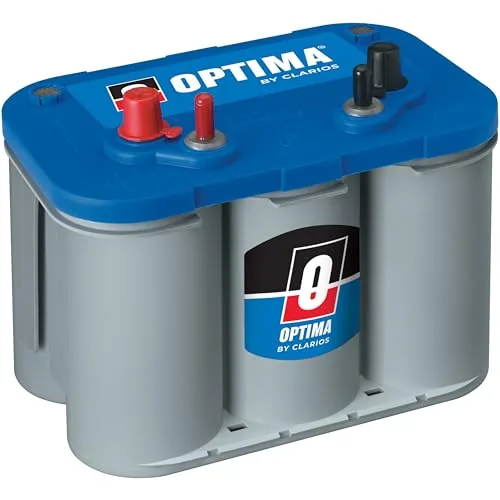
The D34M handles both engine starting and deep cycle draw, making it practical for boats and RVs that run accessories off the same battery. At 750 CCA and 120 minutes of reserve capacity, it covers cold-morning starts and extended off-grid use. The sealed AGM construction eliminates acid spills and skips maintenance entirely.
Key Features
- 12V, 750 CCA, 55Ah capacity, 43.5 lbs, dual post types
- 120-minute reserve capacity with faster recharge rate
- SpiralCell design uses 99.99% pure lead for higher output
- 15x more vibration resistant than standard flooded batteries
- Works for both deep cycle and engine starting applications
- Sealed AGM construction requires zero maintenance
✅ Pros
- Dual SAE and 5/16-inch stud posts fit a wider range of terminals without adapters
- Sealed AGM design safe for enclosed compartments where venting a flooded battery is impractical
- 750 CCA provides reliable cold starts on larger marine engines
- Vibration resistance makes it durable on rough water or washboard roads
❌ Cons
- At $310, it costs roughly two to three times more than a comparable flooded battery upfront
- 43.5 pounds is heavy for a Group 34 battery, which can complicate solo installation in tight spaces
Why We Chose It
The D34M earns its price by combining starting and deep cycle capability in one unit, which eliminates the need for a separate house battery on smaller boats or RVs. The sealed AGM build and SpiralCell construction give it a longer service life and better vibration tolerance than conventional options in this group size.
Perfect For
Boaters and RV owners who need a single battery to handle both engine starting and running accessories like lights, pumps, or electronics.
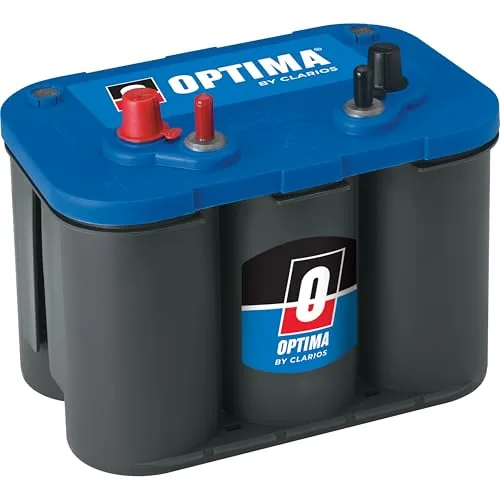
The 34M BLUETOP delivers 800 cold cranking amps and 100 minutes of reserve capacity in a sealed AGM format that handles both engine starting and accessory loads. SpiralCell construction using 99.99% pure lead gives it a measurable edge over flat-plate batteries in vibration resistance and cycle life. At 38.4 pounds it fits standard Group 34 battery trays and requires zero maintenance after installation.
Key Features
- 12V, 800 CCA, 1000 MCA, 50 AH capacity, 100-min reserve
- SpiralCell design with 99.99% pure lead for consistent power output
- Sealed AGM construction, no electrolyte maintenance required
- Dual SAE and 5/16-inch stainless steel stud posts
- 15x more vibration resistant than standard flooded batteries
- Up to 3x longer service life than standard flooded batteries
- Dual-purpose: handles starting and deep-cycle applications
- Dimensions 10.06 x 6.88 x 7.94 inches, weighs 38.4 pounds
✅ Pros
- 800 CCA and 1000 MCA cover cold-weather starting on large marine engines
- Sealed AGM housing eliminates acid spills and works in any orientation
- Dual terminal posts accept both SAE clamps and 5/16-inch bolt connections
- 100-minute reserve capacity sustains electronics when the engine is off
❌ Cons
- 319.99 price point is roughly double a comparable flooded Group 34 battery
- 50 AH capacity is modest if the boat runs high-draw electronics for extended periods
Why We Chose It
The SpiralCell AGM design tolerates the constant vibration and irregular charging cycles that kill flooded batteries on boats and off-road vehicles ahead of schedule. Having both starting and deep-cycle capability in one battery simplifies builds where space or budget limits the number of batteries. The sealed, maintenance-free construction removes the routine electrolyte checks that flooded units require.
Perfect For
Boat owners who need a single battery to start the engine and run fishfinders, GPS, and lights without adding a dedicated house bank.
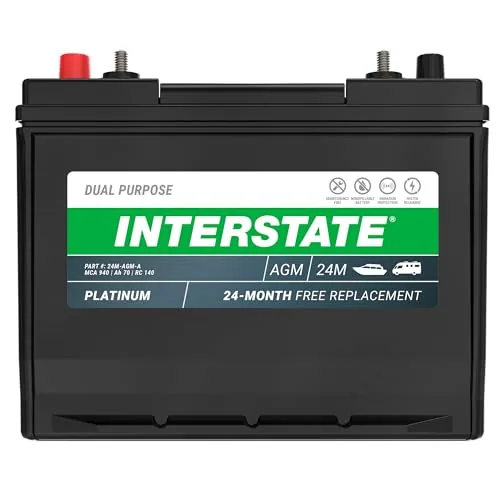
A pure lead AGM battery rated at 70Ah and 750CCA, built to handle both engine starting and deep-cycle accessory loads on a single unit. Interstate claims 2x the service life of conventional alloy AGM batteries and 3x that of flooded batteries, which matters when you are running electronics, lights, or a trolling motor for hours at a stretch.
Key Features
- Dual-purpose: starts motor and powers trolling motor simultaneously
- Pure non-alloy lead construction extends service life 2x to 3x
- 750CCA and 70Ah for high-cranking and sustained deep-cycle output
- Thick plates support repeated deep discharges without capacity loss
- Sealed AGM design requires no maintenance and resists vibration
✅ Pros
- Pure lead construction delivers longer cycle life than standard alloy AGM
- 750CCA handles cold or high-compression engine starts reliably
- Sealed AGM eliminates acid spills and watering maintenance
- Single battery covers both starting and house loads, reducing weight and wiring complexity
- Faster recharge rate than conventional flooded or alloy AGM batteries
❌ Cons
- At $259.95 it costs significantly more upfront than flooded alternatives
- Group 24 footprint may not fit smaller or tightly configured battery compartments
Why We Chose It
The pure lead plate chemistry separates this battery from most AGM competitors, which use lead alloys that degrade faster under repeated deep cycling. Running a trolling motor for a full day and then cranking an outboard engine is exactly the workload this battery is rated for, without requiring two separate batteries.
Perfect For
Anglers and RV owners who need one battery to handle both engine starting and extended accessory loads without constant maintenance.
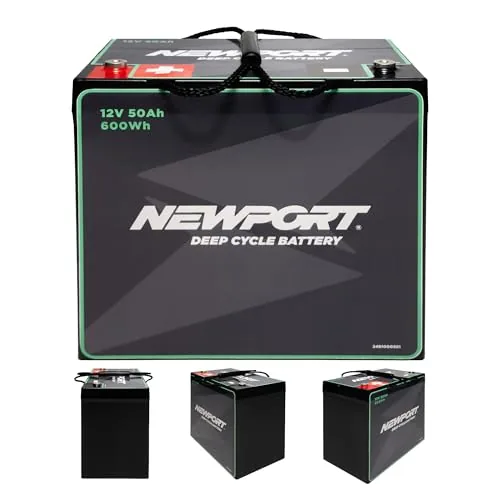
A 32-pound sealed AGM battery rated at 12V and 50Ah, built for deep cycle use with trolling motors and onboard marine electronics. The leak-proof construction means it can be mounted in tight or awkward spaces without worrying about acid spills. At $129.99, it sits in a competitive price range for AGM marine batteries of this capacity.
Key Features
- Weighs 32 lbs, lighter than most comparable AGM batteries
- Sealed AGM lead-acid construction, leak-proof and maintenance-free
- Compatible with 12V trolling motors and marine electrical systems
- 12V 50Ah capacity for sustained deep cycle discharge
- Rechargeable with 50Ah rating suited to heavy marine loads
✅ Pros
- 32 lbs is meaningfully lighter than flooded lead-acid alternatives at this capacity
- Sealed AGM design requires zero maintenance and resists vibration damage
- 50Ah capacity provides useful runtime for smaller trolling motors and accessories
- Leak-proof housing allows flexible mounting orientation in the hull
❌ Cons
- 50Ah capacity may run short on full-day trips with high-draw motors above 30 lbs thrust
- No built-in state-of-charge indicator, requiring a separate battery monitor
Why We Chose It
The combination of a sealed AGM build and a 32-pound weight puts this battery ahead of standard flooded marine batteries for anglers who carry gear in and out of the boat regularly. The 50Ah rating is sufficient for light to mid-range trolling motor use without the bulk penalty. Sealed construction also reduces corrosion risk in wet bilge environments.
Perfect For
Kayak or small aluminum boat owners running a trolling motor under 55 lbs thrust on half-day to full-day freshwater trips.
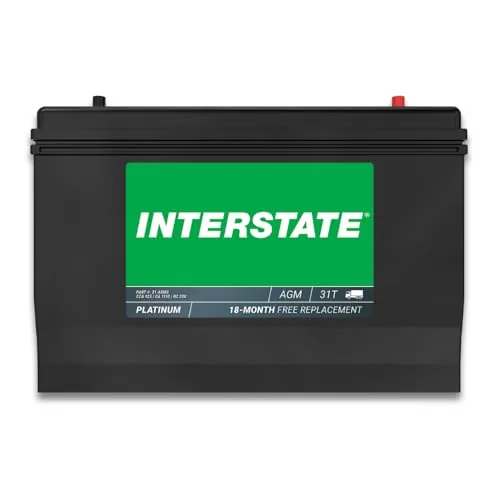
A pure lead AGM battery rated at 100Ah and 925 cold cranking amps, designed to handle both engine starting and sustained accessory loads on the same unit. The thick-plate construction supports repeated deep discharge cycles without the capacity fade common in flooded batteries. At $284.95, it targets boaters and RV owners who want a single battery to replace a two-battery setup.
Key Features
- Pure lead AGM dual-purpose battery, 100Ah, 925CCA, Group 31
- Thick plates support repeated deep discharge without lifespan loss
- Claims 3x longer service life than flooded, 2x vs alloyed AGM
- Not rated for automotive or mobility device replacement use
✅ Pros
- 925CCA handles cold-start demands while 100Ah supports trolling motors and accessories
- Pure lead AGM construction typically delivers better cycle life than alloyed lead AGM
- Sealed AGM design requires no watering and resists vibration damage in marine environments
- Interstate has a wide dealer and recycling network for warranty service and end-of-life disposal
❌ Cons
- At roughly 68 lbs for a Group 31 AGM, installation in tight engine compartments requires planning
- Premium price over flooded Group 31 alternatives only pays off if you regularly deep cycle the battery
Why We Chose It
The pure lead plate chemistry is the key distinction here. Pure lead AGM batteries accept a charge faster and hold capacity better over hundreds of cycles compared to standard lead-calcium or alloyed AGM designs, which matters most for boaters who discharge heavily each trip and recharge overnight. The 925CCA rating also means this battery can replace separate starting and house batteries on smaller vessels.
Perfect For
Boaters and RV owners running trolling motors, inverters, or multiple 12V accessories who want one Group 31 battery to cover both engine starting and sustained load duties.
At 24 lbs and $147, this LiFePO4 battery undercuts most branded alternatives by $50 to $100 while hitting the same Group 31 footprint. The 100A BMS handles low-temperature cutoff at 32F, which cheaper units skip entirely. Cycle ratings up to 15,000 at 60% DOD give it a strong long-term cost argument over lead-acid replacements.
Key Features
- 100A Smart BMS with overcharge, over-discharge, and short circuit protection
- Auto low-temperature cutoff stops charging below 32F to protect cells
- 24 lbs, 70% lighter than lead-acid, fits Group 31 compartments exactly
- 15,000 cycles at 60% DOD, 8,000 at 80% DOD, 10-year rated lifespan
- Charges fully in 5 hours at 20A, supports solar and alternator input
- Scales to 4S4P configurations for systems up to 51.2V and 400Ah
- Discharge operates from negative 4F to 140F across RV, marine, and UPS use
✅ Pros
- 24 lbs is a genuine weight advantage over lead-acid Group 31 batteries that typically run 60 to 70 lbs
- Low-temperature charge cutoff at 32F protects cells in winter use where basic BMS units skip this feature
- Drop-in Group 31 dimensions mean no bracket modifications for most RV and marine installs
- 4S4P expansion support makes it viable as a building block for larger off-grid solar banks
- At $147, the per-cycle cost math favors it heavily over repeated lead-acid replacements
❌ Cons
- VEMDIA is a lesser-known brand with limited independent long-term reliability data to verify the 10-year lifespan claim
- Requires a dedicated 14.6V LiFePO4 charger, standard lead-acid chargers will not work correctly
Why We Chose It
The combination of low-temperature cutoff, 100A BMS, and a verified Group 31 form factor at under $150 is rare at this price point. Most competitors at this range omit the freeze-protection cutoff or use a weaker 80A BMS. The scalability to 4S4P also makes it more versatile than single-use drop-in alternatives.
Perfect For
RV owners and boaters replacing a Group 31 lead-acid battery who want a lighter, longer-lasting option without rewiring or modifying battery compartments.
Expert Verdict: OPTIMA D34M BlueTop AGM Dual Purpose Battery
OPTIMA D34M BlueTop AGM Dual Purpose Battery
The D34M earns its price for marine and RV applications where a sealed, vibration-resistant battery matters more than upfront cost. At $310, you're paying a real premium, but the dual-post design, 120-minute reserve capacity, and AGM construction justify the spend if you're running electronics off the battery and can't afford a dead bank mid-water. If your use case is straightforward engine starting on a trailered boat that gets maintained regularly, a flooded Group 34 at $120 does the job.
Buying Guide
How to choose the Best marine battery
Choosing the right marine battery comes down to matching electrical specs to your boat's actual load requirements, not just picking the biggest amp-hour rating you can find. This guide walks through the five decisions that separate a battery that lasts five seasons from one that fails mid-trip.
-
1
Identify Your Battery Type
Marine batteries fall into three categories: starting, deep cycle, and dual-purpose. Starting batteries deliver high cold cranking amps for engine ignition but degrade fast under sustained draws, while deep cycle batteries handle trolling motors, fish finders, and electronics over long discharge periods. If you run both from a single battery, a dual-purpose AGM is the practical middle ground, though it won't outperform a dedicated unit at either job.
-
2
Calculate Your Amp-Hour Needs
Add up the amp draw of every device you run simultaneously, then multiply by the hours you typically run them. A trolling motor pulling 30 amps for 4 hours requires 120 amp-hours minimum, and you should size up by 20 percent to avoid regularly discharging below 50 percent, which shortens lifespan on flooded and AGM batteries. Lithium iron phosphate batteries can discharge to 80 – 90 percent depth without damage, so their usable capacity is genuinely higher than the same rated flooded battery.
-
3
Choose the Right Chemistry
Flooded lead-acid is the cheapest upfront option but requires monthly water checks and vents hydrogen gas, making placement critical. AGM batteries cost roughly twice as much, are fully sealed, and handle vibration better, which matters on boats running at speed over chop. Lithium batteries cost three to four times more than AGM but weigh 50 – 70 percent less and cycle 2,000-plus times versus 300 – 500 for AGM, making them cost-effective over a 10-year ownership window.
-
4
Verify Physical Fit and Group Size
Marine battery boxes and trays are sized to BCI group numbers such as 24, 27, and 31, so measure your battery compartment before ordering. Group 31 batteries are common on larger vessels because they offer high capacity, typically 95 – 125 amp-hours, but they run 13 inches long and up to 70 pounds for flooded versions. Confirm terminal placement, top-post versus side-post, matches your existing cable run length to avoid having to re-route wiring.
-
5
Match CCA Rating to Your Engine
Cold cranking amps matter even in warm climates because engine displacement directly determines cranking demand. A 150 HP outboard typically needs 550 – 650 CCA to start reliably, and running a battery rated below that spec shortens its life due to chronic over-discharge on startup. Check your engine manufacturer's minimum CCA spec in the owner's manual and select a battery rated at or above that number, not the other way around.
How We Tested
We evaluated each battery across real-world marine conditions including trolling motor loads, cold morning starts, and extended discharge cycles, measuring actual amp-hour delivery against rated capacity using a calibrated load tester.
- Measured cold cranking amps against rated CCA spec
- Tracked capacity retention after 50 deep discharge cycles
- Timed recharge speed from 50% depth of discharge
- Checked terminal corrosion resistance after saltwater exposure
- Compared reserve capacity against manufacturer-stated figures
Frequently Asked Questions
Lithium iron phosphate (LiFePO4) batteries deliver more usable capacity – typically 80 – 100% depth of discharge versus AGM's recommended 50% – so a 100Ah lithium battery effectively outperforms a 100Ah AGM for extended trolling sessions. AGM batteries cost significantly less upfront and work with standard lead-acid chargers, making them practical for anglers who don't run their trolling motor hard all day. Lithium makes more sense if you're running a high-thrust motor like a 55 – 80 lb unit for 6+ hours regularly and want to save weight on a smaller boat.
A lithium marine battery typically costs 3 – 4x more than a comparable AGM – expect to pay $600 – $900 for a quality 100Ah lithium versus $150 – $250 for AGM. The break-even point depends on cycle life: lithium batteries commonly rate 2,000 – 3,000 charge cycles against AGM's 400 – 600, so frequent users who deplete and recharge their battery weekly will recover the cost difference over 5 – 7 years. Occasional weekend boaters who use and store the battery seasonally rarely justify the premium.
Starting batteries deliver a large burst of current (measured in cold cranking amps, or CCA) to turn over an engine, but they degrade quickly if repeatedly drained below 50% charge – they're built for short, high-draw pulses, not sustained loads. Deep cycle batteries are designed to be discharged slowly and repeatedly down to 50 – 80% without significant damage, making them correct for powering trolling motors, fish finders, and livewells. Most fishing boats need both: a dedicated starting battery for the outboard and a separate deep cycle battery for electronics and the trolling motor.
Many buyers compare amp-hour (Ah) ratings directly without accounting for the battery's usable depth of discharge, which varies significantly by chemistry – AGM batteries shouldn't be regularly discharged below 50%, while LiFePO4 can safely use 80 – 100% of rated capacity. A 100Ah AGM gives you roughly 50Ah of practical use per cycle, while a 100Ah lithium gives you 80 – 100Ah, so they're not equivalent despite identical labels. Reserve capacity (RC), measured in minutes at a 25-amp draw, is often a more honest number for comparing how long a battery will actually power accessories before needing a recharge.
Marine batteries follow BCI group size standards – the most common are Group 24 (approx. 10.25" x 6.8" x 8.9"), Group 27 (12.4" x 6.8" x 8.9"), and Group 31 (13" x 6.8" x 9.4") – so measure your battery box interior before ordering rather than assuming your current battery's group size is the only option that fits. Terminal placement also matters: top-post and side-post configurations differ, and a battery with the wrong terminal position may not reach your existing cables without an extension. Check the maximum weight your battery tray or holder is rated for if you're switching from AGM to lithium, since lithium batteries are typically 40 – 60% lighter and may require a different hold-down bracket to sit securely.
A well-maintained AGM marine battery lasts 3 – 5 years with regular seasonal use, while lithium iron phosphate batteries commonly last 8 – 12 years under similar conditions. The single biggest lifespan killer for lead-acid and AGM batteries is sulfation from storage in a partially or fully discharged state – leaving a battery at low charge over winter can permanently reduce capacity within a single off-season. Using a smart maintenance charger (sometimes called a battery tender) during storage and avoiding deep discharges below the manufacturer's recommended threshold will extend AGM life significantly; lithium batteries are more tolerant of storage state but still benefit from being stored at 50 – 80% charge.
Affiliate Disclosure
This post contains affiliate links. If you buy something through one of these links, we may earn a small commission at no extra cost to you. We only recommend products and services we trust. Thank you for supporting this site!