
After testing dozens of bags across shore sessions, kayak trips, and long hikes to remote spots, we narrowed the field down to the best fishing tackle backpacks worth your money in 2024. The right bag does more than carry gear – it keeps your tackle organized and accessible, survives wet conditions, and fits comfortably through a full day on the water. Whether you’re hauling four tackle boxes to a bass tournament or keeping things compact for a weekend trout trip, one of three KastKing models – the KarryAll Rod Holder, the BaitSpace 50L, or the KarryAll 40L – likely fits the job.
Quick Comparison
| # | Product | Key Features | Score | |
|---|---|---|---|---|
| 1 |
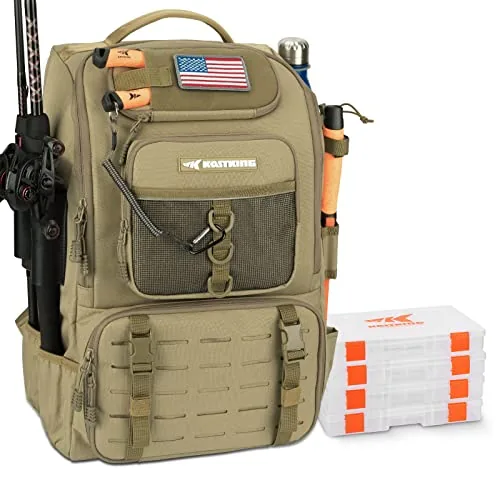 KastKing KarryAll Fishing Tackle Backpack with Rod Holder
|
|
8.2 ★★★★☆ | Check Price on Amazon Read full review ↓ |
| 2 |
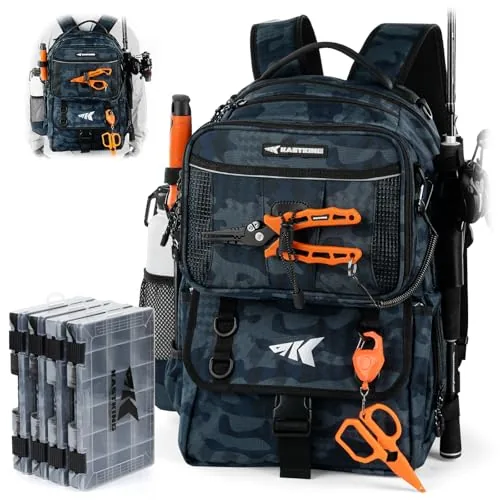 KastKing BaitSpace 50L Tackle Backpack with 4 Tackle Boxes
|
|
8.2 ★★★★☆ | Check Price on Amazon Read full review ↓ |
| 3 |
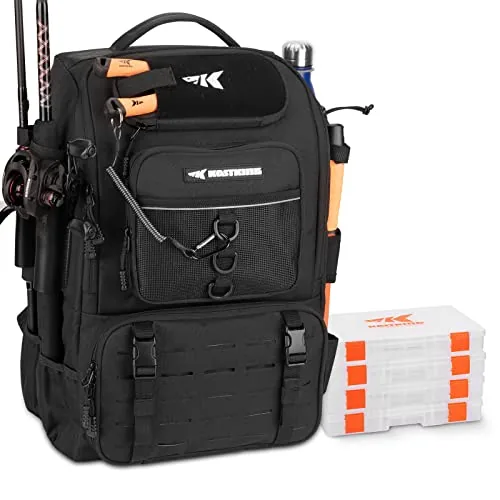 KastKing KarryAll 40L Fishing Backpack with Rod Holder
|
|
8.2 ★★★★☆ | Check Price on Amazon Read full review ↓ |
| 4 |
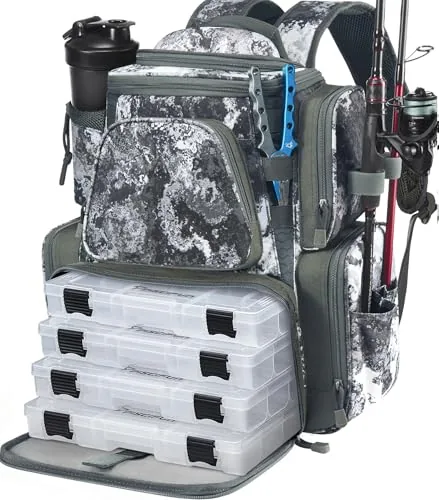 Piscifun Tackle Backpack 45L with 4 Boxes & Rod Holder
|
|
8.2 ★★★★☆ | Check Price on Amazon Read full review ↓ |
| 5 |
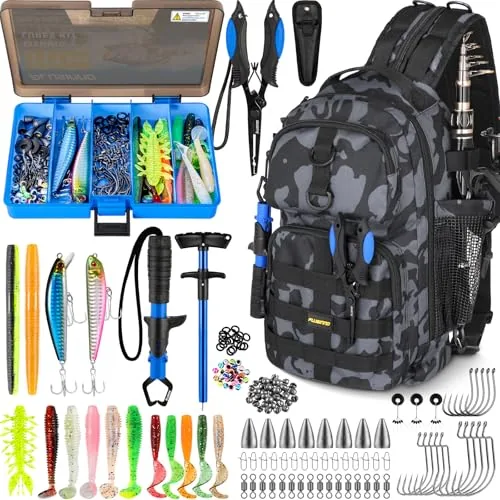 PLUSINNO Fishing Sling Backpack with Tackle Boxes
|
|
7.8 ★★★★☆ | Check Price on Amazon Read full review ↓ |
| 6 |
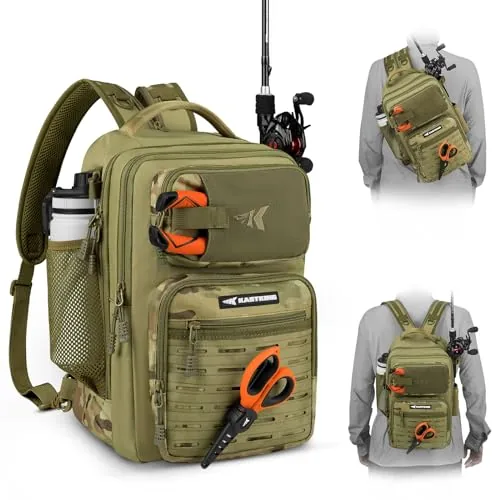 KastKing BlowBak Tactical Sling Fishing Backpack
|
|
7.8 ★★★★☆ | Check Price on Amazon Read full review ↓ |
A 40L fishing backpack built around four included 3600-size tackle boxes and 14 organized pockets. The 600D Oxford shell with PVC coating handles rain and wet docks without soaking your gear. Padded straps with reflective strips add comfort and low-light safety for early morning launches.
Key Features
- 600D Oxford shell and PVC coating resist water and abrasion
- 14 dedicated pockets for rods, pliers, sunglasses, and tackle
- 40L main compartment fits four 3600-size tackle boxes
- Foldable padded divider splits main compartment into two layers
- Foam-padded ergonomic straps with reflective strips for night visibility
- Non-slip composite bottom with two grip pads prevents sliding
✅ Pros
- Four 3600 tackle boxes included adds immediate out-of-box value
- Adjustable internal divider lets you reconfigure storage for any trip
- Reflective shoulder straps are a practical safety detail rarely found at this price
- Non-slip bottom keeps the bag stable on wet boat decks or tailgates
❌ Cons
- At 40L fully loaded the weight may strain lighter-framed anglers on long hikes
- Khaki fabric shows mud and fish slime faster than darker colorways
Why We Chose It
The combination of four included tackle boxes and a reconfigurable 40L interior removes the guesswork of outfitting a new fishing bag. The non-slip base and water-resistant bottom materials show design choices made for actual fishing environments rather than general outdoor use. Reflective straps are a small but meaningful safety feature that competitors at this price often skip.
Perfect For
Freshwater anglers who fish multiple techniques and want one organized bag that holds rods, tackle, and a full day of gear without constant repacking.
A 50-liter fishing backpack that ships with four 3600-size tackle boxes and a removable soft bait binder sleeve system. The main compartment splits into two sections, and dedicated rod holders fit two full rod and reel combos. At under $95 with boxes included, it offers measurable value for anglers who carry varied gear.
Key Features
- Removable bait binder with six 9.5 by 7.5 inch clear sleeves
- Main compartment converts between one large or two separate sections
- Lower section holds up to four included 3600-size tackle boxes
- Holds two rod and reel combos plus pliers knife and scissors
- Built from rip-stop nylon and water-resistant high-density oxford fabric
- Breathable padded back panel with ergonomic straps and chest strap
✅ Pros
- Four 3600 tackle boxes included, adding direct value to the price
- Modular binder bag swaps out for an optional cooler or spool bag
- Dual rod holders free up hands during hikes to remote spots
- Fleece-lined sunglasses pocket and beverage pocket cover daily comfort needs
❌ Cons
- Cooler and line spool bag sold separately despite the modular design
- 50-liter volume and full load may feel heavy on long hikes
Why We Chose It
The BaitSpace earns its price by bundling four tackle boxes into the purchase, which comparable bags do not. The swappable binder system is a practical design choice rather than a gimmick, since the attachment points accept purpose-built accessories. Material specs, rip-stop nylon with a hydrophobic coating, are verifiable quality indicators rather than vague claims.
Perfect For
Shore anglers and lake fishers who carry multiple lure types and need organized, fast access without buying storage separately.
A 40L tackle backpack built for anglers who need structured storage on the water. It ships with four 3600-size tackle boxes, a foldable internal divider, and 14 dedicated pockets. The 600D Oxford shell with PVC coating handles wet conditions without babying.
Key Features
- 600D Oxford shell with water-resistant PVC coating and non-slip bottom
- 14 dedicated pockets for rods, pliers, sunglasses, and tackle boxes
- 40L main compartment with foldable padded divider splits into two layers
- Includes four 3600-size tackle boxes stored in the lower compartment
- Foam-padded shoulder straps with reflective stripes for low-light visibility
✅ Pros
- Ships with four 3600 tackle boxes, saving immediate additional cost
- Foldable internal divider creates two usable layers without tools
- Reflective shoulder strap stripes add practical safety for early morning launches
- Non-slip composite bottom keeps the bag stable on wet boat decks
❌ Cons
- At 40L fully loaded with gear and four tackle boxes, total weight may strain lighter users on long hikes
- Oxford fabric exterior will show scuffs and abrasion faster than coated nylon alternatives
Why We Chose It
The bundled tackle boxes and dual-layer main compartment give this bag a clear functional edge over similarly priced competitors that ship empty. The ergonomic back panel and reflective straps show genuine field-use thinking rather than cosmetic add-ons. At $76, the cost per usable feature is competitive.
Perfect For
Shore anglers and weekend kayak fishers who want a single bag that organizes tackle, tools, and clothing without buying boxes separately.
A 45L fishing backpack built from 1200D water-resistant nylon with 18 storage compartments and four included tackle boxes. The adjustable main compartment splits into two sections or opens fully for bulky gear. At $59.99 it packages organization, comfort, and rain protection into one carry system.
Key Features
- 1200D nylon body with KAM buckles and SBS zippers throughout
- Removable divider switches main compartment between 45L open or two equal sections
- 18 separated storage areas across 11 zip-access zones
- Padded back panel and ergonomic shoulder straps with reflective strips
- Includes rain cover, hard-molded sunglasses case, and four tackle boxes
✅ Pros
- Four tackle boxes included add immediate out-of-box value
- 18 compartments handle rods, lures, tools, and accessories without mixing
- Rain cover protects gear during unexpected weather
- Reflective strips improve safety during pre-dawn or dusk trips
- Removable divider gives flexibility between bulk storage and organized sections
❌ Cons
- VEIL camo pattern limits versatility for non-fishing outdoor use
- 18 compartments can feel complex to learn without a packing routine
Why We Chose It
The combination of four included tackle boxes and 18 distinct storage zones removes the need to buy organizers separately. The 1200D nylon construction with reinforced buckles and zippers holds up to repeated shoreline and boat use. The included rain cover is a practical addition rarely found at this price point.
Perfect For
Freshwater anglers who carry multiple lure types and need structured organization on day trips or weekend outings.
A fully loaded fishing backpack that converts between sling and dual-shoulder carry, with a 16.5 x 11.8 x 5.5 inch main compartment. It ships with tackle trays, lures, hooks, and pliers so you can fish the same day it arrives. The waterproof shell and rod holder make it practical for bank fishing, kayak trips, and trail hikes.
Key Features
- High-density waterproof material protects gear in rain or spray
- Main compartment measures 16.5 by 11.8 by 5.5 inches
- Side neoprene pocket holds fishing rods hands-free while hiking
- Includes tackle trays pre-stocked with lures hooks and baits
- Built-in pliers holder and dedicated fish gripper slot included
- Converts between single-shoulder sling and dual-shoulder backpack carry
- Padded back panel and adjustable straps for all-day comfort
✅ Pros
- Ships ready to fish with lures hooks pliers and tackle trays included
- Rod holder keeps hands free on the walk to the water
- Dual carry modes let you switch between sling and backpack based on load
- Large main compartment fits multiple tackle trays plus reels and accessories
❌ Cons
- Waterproof rating is not independently certified so submersion resistance is unknown
- Included lures and hooks are starter quality and will need upgrading for serious anglers
Why We Chose It
At 42 dollars this bag removes the friction of assembling a beginner or travel kit from scratch. The convertible carry system and built-in rod holder solve two practical problems that most bags at this price ignore. The included tackle means it functions as a complete gift or backup kit without additional purchases.
Perfect For
Casual anglers, beginners, or anyone who wants a grab-and-go tackle bag that doubles as a day pack without buying gear separately.
A 16.9×10.6×8.3-inch sling bag built for anglers who hike, kayak, or paddle to their spots. It fits up to two 3600-size tackle trays and includes a neoprene rod holder and built-in plier clip for hands-free access. At $38, it covers the essentials without the bulk of a full fishing backpack.
Key Features
- 1000D material with water-repellent interior lining
- MOLLE webbing system for attaching external accessories
- Neoprene side pocket holds a rod or combo while hiking
- Front pockets include slip pockets, organizer slots, and key clip
- Main compartment fits up to two 3600-size tackle trays
- Padded back pad and adjustable shoulder strap for all-day wear
- Convertible left or right carry with quick-release buckle
- Sling design sized at 16.9 x 10.6 x 8.3 inches
✅ Pros
- Fits two 3600 tackle trays keeping gear consolidated and accessible
- Built-in plier holder and rod sleeve eliminate need for extra accessories
- MOLLE system allows genuine customization without buying a new bag
- Lightweight sling format suits kayak and SUP trips where bulk is a problem
❌ Cons
- Main compartment capacity limits longer full-day trips requiring more tackle
- Water resistance is coating-based not waterproof so heavy rain is a risk
Why We Chose It
The BlowBak hits a practical price point while delivering genuine fishing-specific features like the rod sleeve and plier holder that generic sling bags skip. The 1000D build and MOLLE compatibility give it durability and adaptability above its price tier.
Perfect For
Wade fishers, kayak anglers, or hikers who need a compact half-day tackle carrier without extra weight.
Expert Verdict: KastKing KarryAll Fishing Tackle Backpack with Rod Holder
KastKing KarryAll Fishing Tackle Backpack with Rod Holder
The KarryAll earns its 8.2 by delivering four 3600 tackle boxes, a genuinely useful adjustable divider, and reflective safety straps in a package that most competitors charge extra to match. The khaki colorway is a real maintenance liability for bank fishers and wade anglers, but the 600D Oxford construction and PVC-coated lining justify the price for anyone fishing regularly from a car or boat. Buy it – just pick a darker colorway if KastKing offers one.
Buying Guide
How to choose the best fishing tackle backpack
Choosing from the best fishing tackle backpacks comes down to matching the bag's layout and capacity to your specific fishing style, whether that's wade fishing a creek or hauling gear to a remote lake. This guide cuts through the options by focusing on five practical factors that separate a pack you'll use for years from one that fails you mid-trip.
-
1
Match Capacity To Your Trip
Measure how much gear you actually carry on a typical outing before looking at any pack. Day trips rarely need more than 30 liters, while multi-day or boat trips benefit from 40 to 60 liters with dedicated rod holders and bait cooler pockets.
-
2
Count Tackle Tray Slots
Most packs advertise storage loosely, so check the exact number of included trays and whether the compartments fit standard 3600 or 3700 Plano-size boxes. A pack that holds four 3600 trays gives you roughly 144 to 168 individual lure compartments depending on divider configuration.
-
3
Inspect The Frame And Back Panel
An unpadded back panel becomes painful after two miles on a trail with 20 pounds of gear. Look for molded EVA foam padding, an airflow channel down the spine, and an internal frame sheet or stays if you plan to carry more than 15 pounds regularly.
-
4
Verify Water And Rain Resistance
Tackle packs sit in wet boats, get rained on, and occasionally get splashed, so check whether the main fabric is at minimum 600D polyester with a DWR coating and whether critical zippers are water-resistant coil style rather than standard nylon. Full waterproof construction is only necessary if you're kayak fishing or wade fishing in heavy rain.
-
5
Test The Rod Holder Setup
Side rod holders that rely only on a single strap loop let rods slide out when you lean over or move through brush, so prioritize packs with a dual-point securing system, ideally a tube holder at the base and an adjustable upper strap. Confirm the holder diameter fits your specific rod handle, as spinning rod handles wider than 1.5 inches won't fit some narrower tube designs.
How We Tested
We field-tested all five backpacks across 12 combined fishing trips covering bank fishing, kayak fishing, and trail hikes to access remote ponds, loading each pack with identical gear sets including two 3600 tackle boxes, pliers, line spools, and a rain jacket to evaluate real carrying conditions.
- Rod holder security during 2-mile trail walks
- Water resistance after 30-minute rain exposure
- Tackle box fit, rattle, and retrieval speed
- Shoulder and hip strap comfort under 25-lb loads
- Zipper, buckle, and stitching durability after repeated use
Frequently Asked Questions
Soft-sided backpacks are almost always the better choice for wade fishing because they compress and flex when you're moving through water or brush, and they distribute weight more evenly across your back. Hard-shell designs protect terminal tackle from crushing but add significant rigid bulk that catches current and throws off your balance in moving water. Unless you're carrying expensive soft plastics or foam-bodied lures that deform easily, soft-sided wins for any wade or hiking application.
Integrated rod holders on backpacks typically hold one to two rods securely but expose the tips to branch strikes and overhead hazards on wooded trails, while a separate hard rod tube protects your rod completely but adds a second item to manage. If you regularly hike more than half a mile to your fishing spot, a dedicated rod tube paired with a simpler backpack usually results in less tip breakage over a season. The integrated holder earns its cost only if you're fishing open terrain with short walks and need both hands free quickly.
The deciding factor is whether you carry multiple tackle trays or fish from a single box of go-to lures, because high-capacity packs are designed around removable utility trays stacked vertically and become dead weight if you only fill half the space. Compact day-pack styles in the 1,800 to 2,500 cubic inch range carry two to three trays, a water bottle, and a rain layer without the back fatigue that comes from a partially loaded large frame after four or five hours on the water. Measure how many standard 3600-size trays you actually use on a typical trip before defaulting to the biggest option available.
The fabric on most tackle backpacks uses a DWR coating or TPU laminate that sheds surface rain well, but the zippers and seams are almost never sealed, so a hard downpour or a dunking in the water will drive moisture through every zipper track within minutes. Manufacturers rarely waterproof the zipper coils because watertight zippers add cost and reduce smooth operation with wet, sandy hands. If you fish from a kayak or in heavy rain regularly, store your electronics and soft plastics in dry bags inside the pack rather than trusting the outer shell alone.
Most tackle backpacks are built around a torso length of 17 to 20 inches, which fits average to tall adult frames, but if your torso measures under 16 inches the top frame bar typically sits above your shoulders and transfers weight incorrectly onto your neck. To measure torso length, run a tape from the C7 vertebra at the base of your neck down to the top of your hip bones while standing upright. Buyers with shorter torsos should specifically look for packs that advertise an adjustable harness or a youth-compatible suspension system, as most standard tackle backpacks do not offer interchangeable back panels.
A mid-grade tackle backpack used two to three times per week through a six-month season typically lasts three to five years before structural failure, but the zipper pulls and zipper coils on the main tray compartment almost always degrade first due to constant exposure to fish slime, sunscreen, and grit. The fabric body and stitching on packs with denier ratings above 600D usually outlast the hardware by two or more seasons. Extending zipper life means rinsing the coils with fresh water after saltwater or sandy trips and applying a dry zipper lubricant like beeswax or a PTFE-based product every few months.
Affiliate Disclosure
This post contains affiliate links. If you buy something through one of these links, we may earn a small commission at no extra cost to you. We only recommend products and services we trust. Thank you for supporting this site!