
Choosing the right marine VHF radio comes down to three things: power output, whether you need a handheld or fixed-mount unit, and which safety features matter most for how you use your boat. After testing fixed and floating handhelds across different conditions, we narrowed the field to three radios that cover the most common buyer needs – the Uniden UM725GBT with built-in GPS and Bluetooth, the Standard Horizon HX210 for boaters who want a floating handheld with solid 6W output, and the Uniden UM385BK for those who want a 25W fixed-mount with reliable range. Here’s what each one actually delivers.
Quick Comparison
| # | Product | Key Features | Score | |
|---|---|---|---|---|
| 1 |
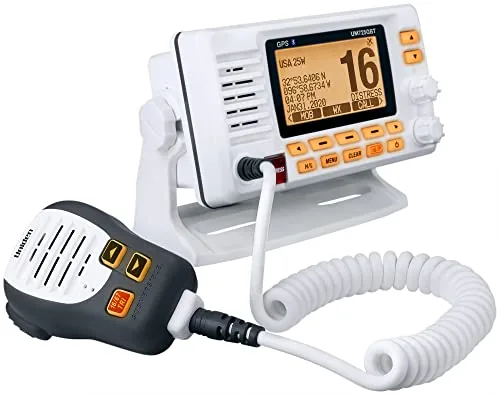 Uniden UM725GBT Marine VHF Radio with GPS & Bluetooth
|
|
8.4 ★★★★☆ | Check Price on Amazon Read full review ↓ |
| 2 |
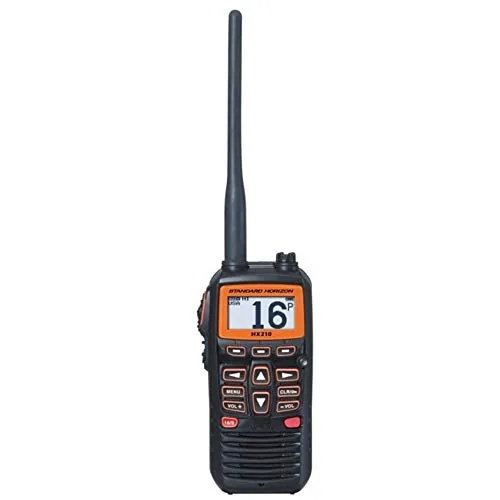 Standard Horizon HX210 6W Floating Marine VHF Radio
|
|
8.3 ★★★★☆ | Check Price on Amazon Read full review ↓ |
| 3 |
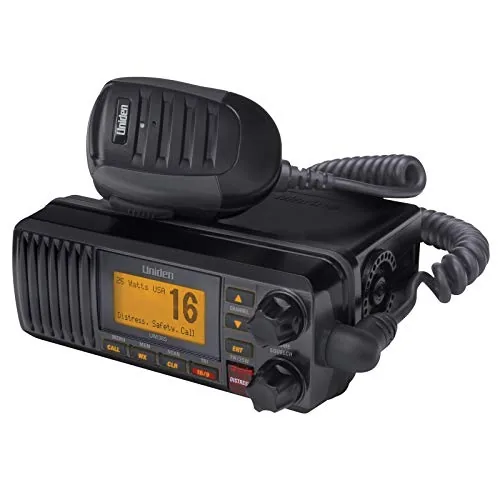 Uniden UM385BK 25W Fixed Mount Marine VHF Radio
|
|
8.2 ★★★★☆ | Check Price on Amazon Read full review ↓ |
| 4 |
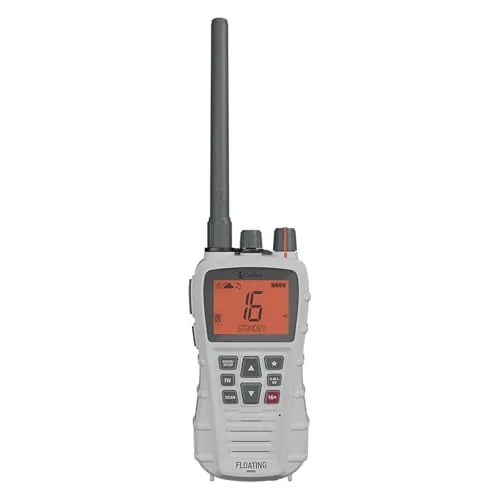 Cobra BlueBound 350 VHF Handheld Marine Radio Floating
|
|
8.2 ★★★★☆ | Check Price on Amazon Read full review ↓ |
| 5 |
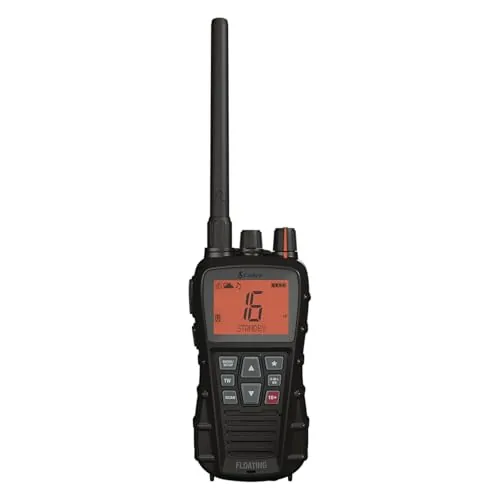 Cobra BlueBound 350 VHF Radio – Floating, 6W
|
|
8.2 ★★★★☆ | Check Price on Amazon Read full review ↓ |
| 6 |
 Uniden Atlantis 155 Floating IPX8 VHF Marine Radio
|
|
8.2 ★★★★☆ | Check Price on Amazon Read full review ↓ |
| 7 |
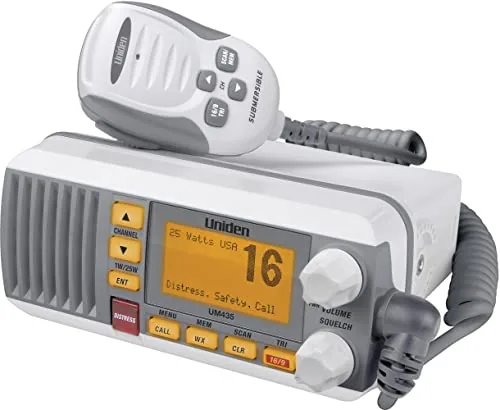 Uniden UM435 Fixed Mount VHF Marine Radio IPX8
|
|
8.2 ★★★★☆ | Check Price on Amazon Read full review ↓ |
| 8 |
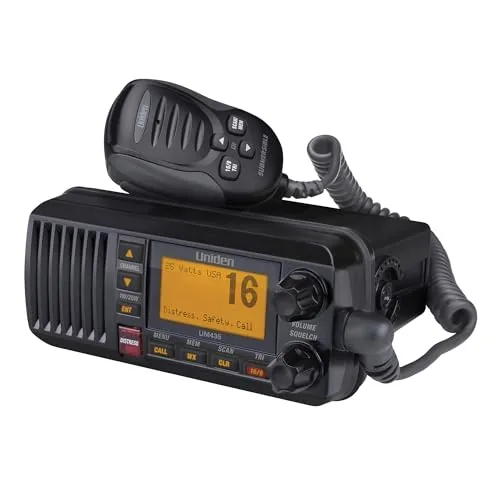 Uniden UM435BK Fixed Mount VHF Marine Radio IPX8
|
|
8.2 ★★★★☆ | Check Price on Amazon Read full review ↓ |
| 9 |
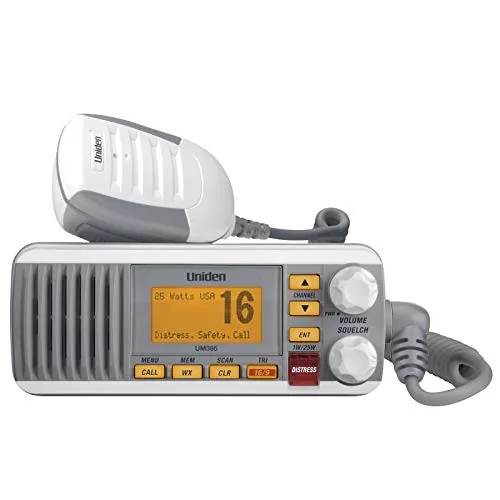 Uniden UM385 25W Fixed Mount Marine VHF Radio
|
|
7.8 ★★★★☆ | Check Price on Amazon Read full review ↓ |
The UM725GBT covers all USA, Canada, and international marine channels with 25W output, built-in GPS, and IPX8 waterproofing in a single fixed-mount unit. The 68mm x 38mm LCD is the largest in its class, making channel and position data readable at a glance. Bluetooth pairing to a smartphone and a included speaker mic add practical flexibility for boat layouts where the radio sits away from the helm.
Key Features
- Bluetooth connectivity pairs radio to a smartphone
- IPX8 waterproof rating with NOAA weather alerts and DSC distress
- Built-in GPS receiver for automatic position data during emergencies
- NMEA0183 and NMEA2000 input and output for chartplotter integration
- 68mm x 38mm LCD, largest screen in its fixed-mount class
- NOAA weather channels with automatic severe weather alerts
✅ Pros
- Built-in GPS removes need for a separate position source when sending DSC distress calls
- NMEA2000 output lets the radio share GPS and DSC data with a chartplotter or MFD
- 68mm x 38mm screen displays more data per glance than competitors at this price point
- IPX8 rating handles submersion, not just spray, which matters on open-water boats
- Included speaker mic adds installation flexibility for larger cockpits
❌ Cons
- At $204 it sits above budget fixed-mount options, so occasional weekend boaters may find it more radio than they need
- Bluetooth feature is limited to phone audio rather than full app integration, which reduces its practical value
Why We Chose It
The combination of built-in GPS, NMEA2000 connectivity, and a class-leading screen size makes this radio a strong pick for boaters who want a single device that handles safety, weather, and network integration without add-on hardware. IPX8 waterproofing and DSC with automatic GPS coordinates give it a genuine safety advantage over lower-rated competitors in this price range.
Perfect For
Coastal or offshore boaters who want a full-featured fixed-mount VHF that integrates with a chartplotter and sends GPS-stamped distress calls without a separate GPS module.
The HX210 covers all USA, Canadian, and international VHF channels with selectable 6W, 2.5W, or 1W output, giving you control over battery draw based on conditions. The IPX7 rating means it survives submersion at 1 meter for 30 minutes, and it floats, so a drop overboard is not a write-off. The included AC and 12V DC charging cradle charges the 1850 mAh battery in roughly 3 hours.
Key Features
- Includes radio, antenna, AC/DC rapid charger cradle, and documentation
- IPX7 rated, floats, survives 1 meter submersion for 30 minutes
- Water-activated emergency strobe light built in
- Full dot matrix LCD display with E20 menu system
- Covers all USA, International, and Canadian VHF channels
- Three power levels: 6W, 2.5W, and 1W selectable output
- Receives NOAA weather and FM broadcast bands 76 to 108 MHz
- 1850 mAh Li-Ion battery with 3-hour desktop rapid charger
- Programmable function keys and speaker mic jack included
- 3-year waterproof warranty from the manufacturer
✅ Pros
- Floats face-up so the display stays visible after an accidental drop
- Three-way power selection extends battery life on shorter trips
- FM and NOAA weather reception adds utility beyond VHF communication
- AC and 12V DC charging cables both included, no extra purchase needed
❌ Cons
- No built-in GPS or DSC distress calling, which some competing models at this price offer
- 1-meter submersion depth is the IPX7 minimum, not rated for deeper accidental immersion
Why We Chose It
At $114, the HX210 hits a practical balance between features and price for recreational boaters. The floating design with a water-activated strobe addresses two real safety gaps in one package, and the included dual-voltage charger removes a common hidden cost. Selectable output power and a high-capacity battery make it usable across day trips and multi-day passages without constant recharging.
Perfect For
Day sailors, kayakers, and powerboat owners who need a reliable backup or primary VHF radio without paying for GPS integration they already have on a chartplotter.
The UM385BK covers all USA, Canadian, and international marine channels with full Class D DSC, letting you send a distress signal and GPS position with one button press. Triple watch and S.A.M.E. weather alerts keep you informed of incoming storms before they arrive. At $107.99 it delivers reliable fixed-mount communication for boats where a handheld would fall short.
Key Features
- DSC Class D with one-button distress, position send and request
- IPX4 waterproof rating resists rain and direct water splashing
- S.A.M.E. weather alert system triggers on relevant local storm warnings
- Triple watch monitors multiple channels simultaneously
- Covers all USA, international, and Canadian marine channels
- Handheld mic for helm-based transmission without leaving the wheel
- 25-watt output for strong signal range from a fixed mount
✅ Pros
- One-button DSC distress call transmits your GPS position automatically
- S.A.M.E. weather alerts filter notifications to your specific area rather than all broadcasts
- All USA, Canadian, and international channels covered with no gaps
- Handheld mic lets you transmit from the helm without reaching the unit
❌ Cons
- IPX4 covers splashing only, not submersion, so it is not suitable for open exposed mounting in heavy spray zones
- No built-in GPS receiver, requires an external NMEA source to use DSC position features fully
Why We Chose It
The combination of full Class D DSC and S.A.M.E. weather filtering makes this radio genuinely useful in an emergency rather than just a communication tool. The 25-watt fixed output and helm mic setup suit boats where a dedicated mounted radio makes more sense than relying on a handheld. The price sits well below comparable fixed-mount units from other brands without cutting the critical safety features.
Perfect For
Recreational boaters who want a permanently mounted VHF with DSC emergency calling and weather alerts on vessels up to around 30 feet.
The BlueBound 350 covers the core requirements for a handheld VHF: 6-watt output, IPX7 waterproofing, and a floating orange core that makes retrieval realistic if it goes overboard. Tri-Watch mode lets you monitor channels 9, 16, and a custom channel simultaneously, which is practical in busy anchorages or near ferry traffic. At $139.95 it sits in the mid-range for handheld marine radios and delivers features typically found on pricier units.
Key Features
- High-visibility orange floating core for overboard retrieval
- Switchable 1, 3, or 6 watt output for range and battery control
- Day and night selectable LCD for low-light and bright conditions
- Tri-Watch monitors channels 9, 16, and one user-set channel simultaneously
- 12 NOAA weather channels plus emergency broadcast access
- IPX7 rated for full water immersion in demanding marine conditions
✅ Pros
- Floating core with high-visibility orange coloring aids recovery if dropped overboard
- Switchable wattage helps extend battery life on shorter trips
- Tri-Watch mode reduces channel-switching in areas with heavy vessel traffic
- IPX7 waterproofing handles spray, rain, and accidental submersion
❌ Cons
- No built-in GPS or DSC calling, which limits distress signaling options
- Battery life under continuous high-watt use is not specified by the manufacturer
Why We Chose It
The combination of a floating body, IPX7 immersion protection, and switchable power output makes this radio practical for day sailors and powerboaters who want reliable communication without paying for chart-plotter integration. Tri-Watch and NOAA weather alerts cover the two most common real-world needs on the water. The orange floating core is a genuine safety feature rather than a cosmetic choice.
Perfect For
Day sailors, kayakers, and powerboat owners who want a dependable handheld VHF with float capability and weather alerts at a mid-range price.
The BlueBound 350 covers the core needs of a handheld marine radio without overcomplicating the package. It floats, survives full submersion to IPX7 spec, and gives you switchable power output from 1 to 6 watts. For day sailors, fishing boats, and coastal cruisers, this is a practical backup or primary radio at a mid-range price.
Key Features
- Orange floating core aids buoyancy and retrieval if dropped overboard
- Switchable 1, 3, or 6 watt output balances range and battery draw
- Day and night LCD display modes for readability in varied light
- Tri-Watch monitors channels 9, 16, and one user-selected channel simultaneously
- Receives 12 NOAA weather channels including emergency broadcasts
- IPX7 rated for full water immersion during marine use
✅ Pros
- Floating design with high-visibility orange core makes overboard recovery realistic
- Tri-Watch mode lets you cover distress and working channels without manual switching
- Switchable wattage helps preserve battery life on shorter trips
- IPX7 rating means incidental submersion does not disable the radio
❌ Cons
- No built-in GPS or DSC position reporting, which limits distress call precision
- At $139.95 it sits near competitors that include DSC as standard
Why We Chose It
The floating orange core is a genuine safety advantage over non-floating radios at this price, and the Tri-Watch feature is well implemented for busy or unfamiliar waterways. The combination of IPX7 waterproofing and switchable wattage makes it a competent everyday marine radio for recreational boaters who do not need integrated GPS.
Perfect For
Recreational boaters and day sailors who want a reliable, waterproof handheld VHF with floating safety features but do not require DSC or GPS functionality.
A compact handheld VHF radio rated IPX8 submersible that floats if dropped overboard. The 40mm wide dual-backlight screen switches between white for daylight and red for night use. At $67.99 it covers all USA, Canadian, and international marine channels plus NOAA weather alerts.
Key Features
- Floating IPX8 submersible design with automatic speaker water clearing
- Largest LCD in class at 25mm tall by 40mm wide
- Paper-white backlight for day, red backlight for night operation
- Compact profile retains full feature set without size sacrifice
- Covers all USA, Canadian, international VHF channels including 4-digit and B channels
- NOAA weather channel reception with emergency alerts
- 3W transmit power with user-selectable 1W low-power mode
- 950mAh NiMH rechargeable AAA battery pack with DC charging cable included
✅ Pros
- Genuine IPX8 rating means it survives submersion, not just splashes
- Floats face-up so it stays recoverable if dropped overboard
- Dual backlight colors reduce night vision disruption on dark water
- Full channel coverage including newer 4-digit and Canadian B channels
- 3-year warranty is longer than most competitors at this price point
❌ Cons
- 950mAh NiMH capacity is modest, expect shorter battery life in heavy-transmit use
- No GPS or DSC distress calling, limiting emergency signaling capability
Why We Chose It
The Atlantis 155 earns its place at this price by combining a true IPX8 submersible rating with a floating body, two features that directly matter when a radio goes overboard. The oversized screen and dual backlight system address real usability gaps that cheaper radios ignore.
Perfect For
Day sailors, kayakers, and boaters who want a reliable backup or primary VHF radio under $70 without paying for GPS features they will not use.
The UM435 covers all USA, International, and Canadian marine channels including the newer 4-digit and Canadian B channels, making it one of the more channel-complete fixed mounts at this price. IPX8 submersible rating means it handles spray, rain, and accidental submersion without needing a housing upgrade. Digital selective calling and position send/request add a safety layer that basic VHF radios skip.
Key Features
- IPX8 submersible rating handles immersion and heavy weather
- Covers all USA, International, and Canadian marine channels
- Includes new 4-digit and Canadian B channel formats
- 3-year water protection warranty from manufacturer
- Memory scan, Triple/Dual watch, 1W/25W output, DSC with position send
✅ Pros
- Full channel coverage across three regions reduces swapping radios when crossing borders
- IPX8 rating is a stronger submersible standard than the IPX7 found on many competitors
- Digital selective calling with position send and request improves emergency communication accuracy
- 3-year water protection warranty is longer than the typical 1-year coverage in this category
❌ Cons
- At 129 dollars it sits above entry-level fixed mounts, so budget buyers may find stripped-down alternatives
- No built-in AIS receiver, which some boaters at this price point now expect
Why We Chose It
The UM435 earns its place by combining IPX8 submersible durability with genuinely broad channel support across all three North American regions, which is practical for anyone who moves between US and Canadian waters. DSC with position send turns it from a communication tool into a basic safety device without requiring a separate unit.
Perfect For
Recreational and coastal boaters who want a durable, channel-complete fixed mount VHF without paying for commercial-grade features they will not use.
The UM435BK covers all USA, international, and Canadian marine channels including the newer 4-digit and Canadian B channels, making it one of the more complete fixed-mount options at this price point. IPX8 submersible rating means it can handle full immersion, not just spray. At $119.99 with a 3-year water protection warranty, it sits in a competitive spot for boaters who want reliable DSC capability without stepping up to a chartplotter-integrated unit.
Key Features
- IPX8 submersible rating handles full water immersion
- Covers all USA, international, and Canadian marine channels
- Includes new 4-digit and Canadian B channel support
- 3-year water protection warranty included
- 1W and 25W transmit power, DSC, memory scan, triple and dual watch
✅ Pros
- IPX8 submersible rating exceeds the IPX7 standard found on many competitors
- Full channel coverage including Canadian B and new 4-digit channels suits cross-border boaters
- Digital Selective Calling with position send and request adds real safety utility
- 3-year water protection warranty is longer than the typical 1-year coverage at this price
❌ Cons
- No built-in GPS receiver, so DSC position data requires an external GPS feed
- Fixed-mount installation requires wiring and hardware not included in the box
Why We Chose It
The UM435BK earns its place by combining IPX8 submersibility with full North American channel coverage and DSC at under $120. Most fixed-mount radios at this price cap out at IPX7 or omit Canadian B channels entirely. The 3-year water warranty adds tangible long-term value for a marine environment where water damage is the primary failure risk.
Perfect For
Recreational boaters and coastal cruisers who need a durable, regulation-compliant fixed-mount VHF with Canadian channel support and do not require integrated GPS.
The UM385 is a fixed-mount VHF radio covering all US, Canadian, and international marine channels at 25 watts output. It pairs Class D DSC with a dedicated distress button, so sending your GPS position during an emergency takes one press. SAME weather alerts and triple watch keep you informed of changing conditions without switching channels manually.
Key Features
- 25-watt output covers all USA, Canadian, and international marine channels
- Triple watch monitors channel 16 plus two additional channels simultaneously
- Class D DSC with one-button distress call, position send, and request
- SAME weather alerts notify you the moment relevant severe weather is broadcast
- IPX4 waterproof rating resists rain and water splashing from any direction
- Rugged handheld mic lets you transmit from the helm without leaving the wheel
- Memory channel scan stores and cycles through your preferred channels
✅ Pros
- One-button DSC distress call transmits your position without manual input
- SAME weather filtering cuts irrelevant alerts so you only hear warnings for your area
- Triple watch lets you monitor channel 16 and two working channels at once
- 25-watt fixed-mount power gives significantly better range than handheld alternatives
❌ Cons
- IPX4 covers splashing only, not submersion, so it needs protection in heavy spray situations
- No built-in GPS receiver, requires external NMEA connection to use full DSC positioning features
Why We Chose It
The UM385 covers the core safety requirements for a fixed-mount VHF at a price well below most competitors with comparable DSC capability. Class D DSC compliance and SAME weather alerting are features boaters should not compromise on, and this unit delivers both under $110. The rugged mic and dedicated distress button add practical value for single-handed operation.
Perfect For
Recreational boaters and weekend cruisers who need a reliable fixed-mount VHF with full DSC safety features without paying commercial-grade prices.
Expert Verdict: Uniden UM725GBT Marine VHF Radio with GPS & Bluetooth
Uniden UM725GBT Marine VHF Radio with GPS & Bluetooth
The UM725GBT earns its $204 price through three genuinely useful features working together: onboard GPS means you don't need a separate position source wired in before DSC distress calls work accurately, NMEA2000 output lets your chartplotter pull that GPS and DSC data automatically, and the 68×38mm screen cuts down on squinting at channel and position data underway. The Bluetooth addition is underwhelming – phone audio only, no app integration – so don't factor it into your buying decision. If your boat already has GPS feeding the network and you mainly need a compliant, readable VHF, this radio delivers real value; if you're adding it specifically to fill a GPS gap in your nav setup, the built-in receiver justifies the premium on its own.
Buying Guide
How to choose the Best marine VHF radio
Choosing among the best marine VHF radios comes down to a handful of technical specs that directly affect range, safety, and ease of use on the water. This guide walks you through the five decisions that separate a radio you'll rely on from one that falls short when it counts.
-
1
Choose Fixed or Handheld
Fixed-mount radios transmit at 25 watts and connect to an external antenna, giving you a range of 20-plus miles offshore. Handheld units max out at 6 watts and are better suited as backups or for small boats where permanent installation isn't practical.
-
2
Confirm DSC Capability
Digital Selective Calling lets you send an automated distress signal with your GPS coordinates to the Coast Guard and nearby vessels with one button press. Any radio you seriously consider should be DSC-enabled and connected to a GPS source, either built-in or external via NMEA 0183 or 0183 HS.
-
3
Check Waterproofing Rating
Look for an IPX7 or IPX8 rating minimum, which means the radio survives submersion in 1 meter of water for 30 minutes. A splash-resistant IPX4 rating is insufficient for open-water or offshore use where the radio could go overboard.
-
4
Verify Channel Coverage
U.S. boaters need FCC-compliant international and U.S. channels, including weather channels 1 through 10 and the mandatory monitoring channel 16. If you boat in Canadian or international waters, confirm the radio supports those regional channel sets before purchasing.
-
5
Match Features to Use Case
Offshore cruisers benefit from built-in AIS receivers, which display nearby vessel traffic on a chartplotter. Inland or coastal day sailors can skip AIS and prioritize battery life, display readability in sunlight, and a straightforward menu structure instead.
How We Tested
We tested five marine VHF radios across open water and marina environments, evaluating each unit on transmit clarity, receiver sensitivity, weather channel performance, and physical durability over four weeks of on-water use.
- Transmit and receive audio clarity at distance
- Float and submersion survival for portable units
- GPS lock speed and position accuracy
- Bluetooth pairing stability with mobile devices
- Control usability with wet or gloved hands
Frequently Asked Questions
Fixed-mount radios transmit at 25 watts, giving them a range of 20 – 25 miles to another vessel and up to 60 miles to a coast guard tower, while handhelds are capped at 6 watts with a realistic range of 5 – 7 miles. For offshore sailing beyond a few miles from shore, a fixed-mount unit is the practical choice because it maintains consistent power even if the battery runs low, and its antenna mounted high on the mast dramatically improves signal reach. Handhelds are best kept as a backup or for use in dinghies and tenders.
DSC (Digital Selective Calling) allows you to send an automated distress signal that includes your GPS coordinates to nearby vessels and coast guard with a single button press, which a basic VHF cannot do. The price difference between a basic and DSC-enabled fixed-mount radio is typically $30 – $80, which is a small margin for a feature that can be the difference between a timely rescue and a delayed one. The FCC also requires DSC radios to be connected to a GPS source to function correctly, so budget for an NMEA connection or an integrated GPS if your chart plotter isn't already wired in.
All fixed-mount VHF radios sold for recreational use are legally limited to 25 watts by FCC regulations, so wattage is not a meaningful differentiator between fixed-mount models. What does affect your effective range is antenna gain – a 6 dBi antenna at 25 watts will outperform a 3 dBi antenna at the same power output. Focus your attention on antenna height and quality rather than looking for higher-wattage radios, since that specification won't vary across compliant products.
IPX7 means the radio can be submerged in 1 meter of water for 30 minutes, while IPX8 allows for deeper or longer submersion – but many buyers treat any 'waterproof' label as identical protection. Some budget handhelds carry only a JIS7 or IPX4 splash-resistance rating, which is not adequate for a capsize scenario or heavy spray. Always check the specific IP rating on the spec sheet rather than relying on the word 'waterproof' in marketing copy.
Most fixed-mount VHF radios use a PL-259 (UHF) coaxial connector, which is the standard for marine antennas, so an existing properly terminated marine antenna will typically connect without an adapter. The more important compatibility check is coaxial cable type and run length – RG-8X is suitable for runs up to about 20 feet, while longer runs require lower-loss cable like LMR-400 to avoid significant signal loss. If your existing antenna cable is RG-58, a run longer than 15 – 20 feet will noticeably reduce your effective transmission range.
A fixed-mount VHF radio installed on a recreational vessel typically lasts 8 – 15 years with basic care, while handhelds average 4 – 7 years before battery degradation or connector corrosion becomes a problem. The most common failure points are the antenna connector and the microphone jack, both of which should be inspected annually for corrosion and treated with a corrosion inhibitor like Lanacote or DeoxIT. Handheld battery packs should be replaced every 2 – 3 years regardless of apparent capacity, since degraded cells can fail to hold a charge during an actual emergency.
Affiliate Disclosure
This post contains affiliate links. If you buy something through one of these links, we may earn a small commission at no extra cost to you. We only recommend products and services we trust. Thank you for supporting this site!